




• Login
Upgrade
JStories
  • 日本語
  • 繁体字中文
No Result
View All Result
  • Home
  • AI
    • Artificial Intelligence
    • Robotics
    • Mobility
    • FinTech
    • Quantum
  • Earth
    • AgriTech
    • Green Innovation
    • Disaster Tech
    • SpaceTech
    • Materials
  • Life Sciences
    • BioTech
    • HealthTech
    • MedTech
    • AgeTech
  • Society
    • Media
    • EdTech
    • Diversity
    • FemTech
    • Social Impact
  • Lifestyle
    • FoodTech
    • Beauty & Fashion
    • Wellbeing
    • Arts & Music
    • Anime
  • Travel
    • Adventure Travel
    • Luxury Travel
    • Wellness & Medical Tourism
    • Culture
  • Video
  • Deals
    • Venture Capital
    • M&A
    • Events
    • Pitch
    • Growth Support
    • Legal & IP
  • Interview
  • Opinion
en English ja 日本語 zh 繁体字中文
JStories
No Result
View All Result

An egg substitute with the texture and umami of real egg

Yoshiko Ohira by Yoshiko Ohira
11/17/2023
in FoodTech, Lifestyle, News, Wellbeing
0
Home Lifestyle FoodTech
Share on FacebookShare on Twitter

J-STORIES –  Chicken eggs are used in cooking all over the world, but climate change and soaring commodity prices are a serious threat to chicken farming. In Japan and other countries, the spread of bird flu has resulted in mass poultry culls. Meanwhile, amid a trend for “ethical consumption”, more and more shoppers are shunning chicken eggs.

Perhaps these issues could be addressed while still retaining the delicious texture and taste of egg. That was the challenge a Japanese startup set itself. And its solution was to develop an egg substitute made mainly from the traditional Japanese ingredient of konjac flour. “Umami Egg” by Tokyo-based Umami United Japan is now being marketed in Japan and overseas.

Umami Egg is 100% plant-based. It also has a long shelf-life, so can serve as emergency food.     Source: Umami United Japan

Although Umami Egg comes in the form of a powder, when used in cooking its taste and texture is similar to real chicken eggs. For example, omelets and scrambled eggs can be made just by mixing the powder with soy milk and heating. According to the company, it can also replace eggs in French toast, caramel custard, and baked goods.

When mixed with soy milk, Umami Egg can be used to make pancakes.     Source: Umami United Japan

Umami Egg is not the first plant-derived egg substitute, but one of its unique characteristics is its texture similar to that of real egg. Made with konjac flour and bittern (a coagulant used in the production of tofu), when heated it has a fluffy and moist texture like that of tofu or konnyaku. According to CEO Hiroto Yamazaki, this is quite unlike the dry texture of existing soybean-based egg substitutes.

The key to another Umami Egg characteristic is in its name. The company uses unique technology to process kikurage (jelly ear) mushrooms, reproducing the taste and umami of real egg. As the mushrooms would otherwise be discarded because of overproduction, an added benefit is the prevention of food loss.

Twenty-five grams of Umami Egg powder costs 1,500 yen (retail price) and can produce 500 grams of plant-based egg, which is the equivalent of ten medium-sized chicken eggs. Although this is more expensive than real eggs, the product is ideal for vegetarians, vegans, and those who cannot eat eggs due to medical reasons such as egg allergy or needing to reduce cholesterol intake.

What’s more, because the powder can be stored for long periods of time, it could serve as a food source during emergencies or in the event that egg production cannot keep up with popular growth.

Yamazaki told J-Stories that Umami Egg was inspired by his experiences as a student guiding foreign tourists in Japan.

“For various different reasons, such as veganism, allergies, or religion, many people cannot eat certain foods. I realized that food diversification is still lagging, not just in Japan, but around the world,” said Yamazaki.

After graduating, he continued to work on “food diversity” and set up his company in 2023.

“I want to break down barriers and create a world where people from different backgrounds can sit around the same table.”
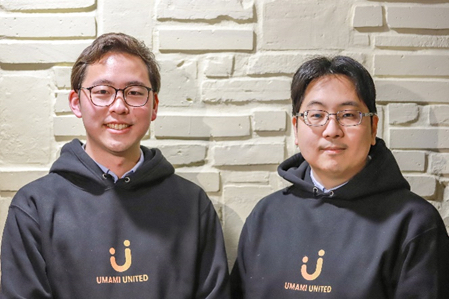
Umami United Japan CEO Hiroto Yamazaki (left) and CTO Kunihiro Oba.     Source: Umami United Japan

Currently, the company’s main customers are food manufacturers and hotels that produce and sell sweets and baked goods. Yamazaki aims to expand sales overseas to suppliers of meals to American universities and corporations. To this end, the company raised a total of $500,000 from overseas investors in January and then another 240 million yen in August.

The company is also working on a new product that could replace egg whites, which are used in large quantities in the confectionery, noodle, and fish paste industries. Currently, it is close to completing a trial product.

While the company’s current egg substitute requires customers to add liquid such as soy milk, Yamazaki says he hopes to one day offer a product that fully replaces real egg by itself.

Translated by Tony McNicol

Top page photo provided by Umami United Japan

For inquiries about this article, please contact [email protected]


Tags: eggjapanese foodumami
Previous Post

Sustainable Harvest: Japanese Students Harness Tech for Agriculture’s Future

Next Post

INTERVIEW | Shining behind the scenes of media: Interns with diverse backgrounds supporting J-Stories

Yoshiko Ohira

Yoshiko Ohira

Related Posts

日本のスタートアップはなぜルクセンブルクを目指すのか
Growth Support

Why Japanese Startups Are Setting Their Sights on Luxembourg

by JStories Editorial Team
10/20/2026
脱炭素、何から始める? CO2排出量をオンラインで「見える化」
Green Innovation

‘Visualizing’ Greenhouse Gas Emissions to Support Corporate Climate Efforts

by Ayaka Sagasaki
09/24/2026
ディープテックとAI、地球課題に挑む新興10社の「実装力」
Artificial Intelligence

Deep Tech and AI: 10 Startups Tackling Global Challenges With Market Execution

by JStories Editorial Team
09/15/2026
Japan looks to Latin America for the minerals powering AI — and the IDB offers to be the bridge
Deals

Japan looks to Latin America for the minerals powering AI — and the IDB offers to be the bridge

by Toshi Maeda
08/29/2026
What matters is not what you build, but who you build it with
Events

What matters is not what you build, but who you build it with

by Ikeda Masaru
08/28/2026
Next Post

INTERVIEW | Shining behind the scenes of media: Interns with diverse backgrounds supporting J-Stories

Leave a Reply Cancel reply

Your email address will not be published. Required fields are marked *

Trending

Greening the desert with trash

by Yui Sawada
03/23/2023
0

KYOTO (JStories) - The sight of local Niger women throwing kitchen waste out into the African desert inspired a project...

ディープテックとAI、地球課題に挑む新興10社の「実装力」

Deep Tech and AI: 10 Startups Tackling Global Challenges With Market Execution

by JStories Editorial Team
09/15/2026
0

TOKYO — Ten prominent startups presented their pitches at the "SusHi Tech Global" media conference supported by the Tokyo Metropolitan...

Organic power packs

by Ayaka Sagasaki
12/29/2023
0

J-STORIES ー While rechargeable batteries today rely on rare metals and have a relatively short lifespan, a Japanese company has...

A pocket-size AED innovation to save more lives

by Suvendrini Kakuchi
09/11/2025
0

JStories ー A Japanese startup has developed a pocket-size automated external defibrillator (AED) — about the size and weight of...

Antibodies that grow teeth in wild-type mice. Source: Toregem Biopharma

World’s first ‘teething drug’ clinical trial starts in September – Aiming for full commercialization by 2030

by Ruriko Kokubun
06/07/2024
0

Editor's Note: This article has been updated with new information. It was originally published on 09/22/2023. J-STORIES - The conventional...

JStories

©Articles and photos published on JStories are protected by Japanese copyright law and international treaties. They cannot be reproduced without the permission of the copyright holders

Explore JStories

  • Home
  • About JStories
  • JStories Newsletter Sign-Up
  • Company
  • Team
  • Contact
  • Privacy Policy
  • Partner Press Releases

Follow Us

Welcome Back!

Login to your account below

Forgotten Password?

Retrieve your password

Please enter your username or email address to reset your password.

Log In
No Result
View All Result
  • TOP STORIES
  • AI
    • Artificial Intelligence
    • Robotics
    • Mobility
    • FinTech
    • Quantum
  • Earth
    • AgriTech
    • Green Innovation
    • Disaster Tech
    • SpaceTech
    • Materials
  • Life Sciences
    • BioTech
    • HealthTech
    • MedTech
    • AgeTech
  • Society
    • Media
    • EdTech
    • Diversity
    • FemTech
    • Social Impact
  • Lifestyle
    • FoodTech
    • Beauty & Fashion
    • Wellbeing
    • Arts & Music
    • Anime
  • Travel
    • Adventure Travel
    • Luxury Travel
    • Wellness & Medical Tourism
    • Culture
  • Video
  • Deals
    • Venture Capital
    • M&A
    • Events
    • Growth Support
    • Legal & IP
  • Interview
  • Opinion

©Articles and photos published on JStories are protected by Japanese copyright law and international treaties. They cannot be reproduced without the permission of the copyright holders

Not enough quota to unlock this post
Unlock left : 0
Are you sure want to cancel subscription?