



• Login
Upgrade
JStories
  • 日本語
  • 中文 (中国)
No Result
View All Result
  • Home
  • AI
    • Artificial Intelligence
    • Robotics
    • Mobility
    • FinTech
    • Quantum
  • Earth
    • AgriTech
    • Green Innovation
    • Disaster Tech
    • SpaceTech
    • Materials
  • Life Sciences
    • BioTech
    • HealthTech
    • MedTech
    • AgeTech
  • Society
    • Media
    • EdTech
    • Diversity
    • FemTech
    • Social Impact
  • Lifestyle
    • FoodTech
    • Beauty & Fashion
    • Wellbeing
    • Arts & Music
    • Anime
  • Travel
    • Adventure Travel
    • Luxury Travel
    • Wellness & Medical Tourism
    • Culture
  • Video
  • Deals
    • Venture Capital
    • M&A
    • Events
    • Pitch
    • Growth Support
    • Legal & IP
  • Interview
  • Opinion
  • Home
  • AI
    • Artificial Intelligence
    • Robotics
    • Mobility
    • FinTech
    • Quantum
  • Earth
    • AgriTech
    • Green Innovation
    • Disaster Tech
    • SpaceTech
    • Materials
  • Life Sciences
    • BioTech
    • HealthTech
    • MedTech
    • AgeTech
  • Society
    • Media
    • EdTech
    • Diversity
    • FemTech
    • Social Impact
  • Lifestyle
    • FoodTech
    • Beauty & Fashion
    • Wellbeing
    • Arts & Music
    • Anime
  • Travel
    • Adventure Travel
    • Luxury Travel
    • Wellness & Medical Tourism
    • Culture
  • Video
  • Deals
    • Venture Capital
    • M&A
    • Events
    • Pitch
    • Growth Support
    • Legal & IP
  • Interview
  • Opinion
en English ja 日本語 zh 中文 (中国)
JStories
No Result
View All Result

Japanese researchers fight global warming tide with ‘Blue Carbon’

Revival of seaweed and sea grass beds seen as key to boosting ocean carbon storage

Ayaka Sagasaki by Ayaka Sagasaki
08/04/2023
in AgriTech, Earth, Green Innovation, News
0
Home Earth AgriTech
Share on FacebookShare on Twitter

J-STORIES – Just like plants and trees on land, marine plants such as seaweeds and seagrasses absorb CO2 via photosynthesis and store it in the ocean. This mechanism is known as “blue carbon” and has the potential to be an even quicker and more efficient way to store carbon than land-based “green carbon.”

Key players in the varied blue carbon ecosystem of carbon-sequestration include tropical mangroves, eelgrass and other seaweeds growing in coastal waters about 2 meters deep, and also large seaweeds such as arame, kajime, and wakame growing in deeper waters. Large, fast-growing seaweeds play a particularly important role, as do coastal wetlands and tidal flats.
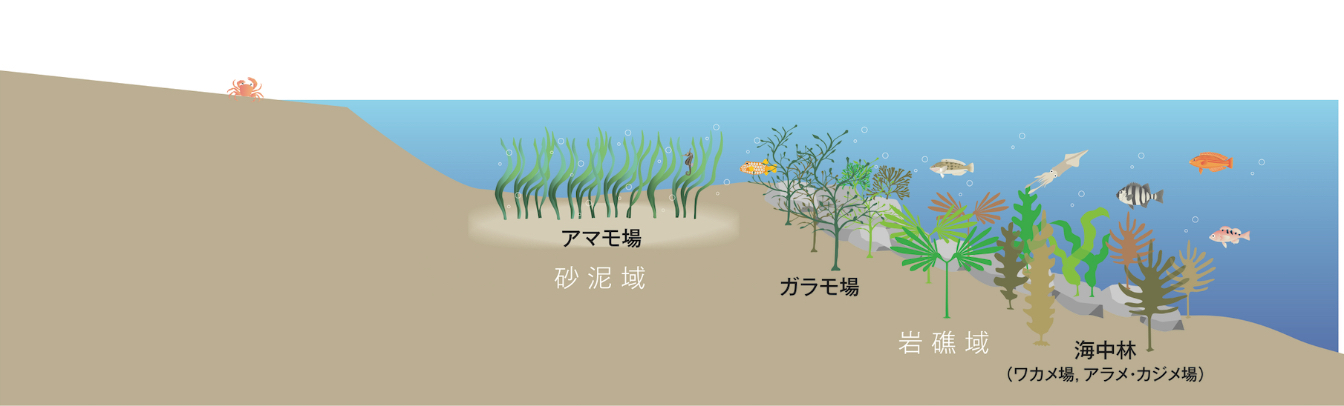
Large seaweeds and sea grasses store carbon in a similar way to plants and trees on land.    Source: Kajima Corp.

In recent years, however, warmer seas have led to a conspicuous decline in seaweed beds, threatening this blue carbon mechanism, even as global warming becomes an ever more serious issue. Amid this worldwide crisis, Japanese companies are working with the government to safeguard and revive seaweed and seagrass beds.

Last year, Kajima Corp., a major Japanese construction company, announced that it had developed technology to grow large seaweeds. The Kanagawa-based Hayama Marine Science Laboratory, which is part of the Kajima Technical Research Institute, has been restoring eelgrass beds since around 2002. Around five years ago, researchers confirmed a decline in arame seaweed and other large algae beds. Then in 2020 they confirmed that these had disappeared entirely. For this reason, they started work to develop ways to regenerate large algae.

In order to regenerate lost seaweed beds, gametophytes (equivalent to seaweed “seeds”) are collected from mother algae and stored in flasks of water. Arame seedlings are then mass-produced through a technology developed by researchers. Unlike transplanting seedlings or scattering spores, this “free gametophyte technology,” is capable of regenerating entire seaweed beds. In fact, having regenerated an arame bed using this method, a few months later researchers confirmed that Japanese red seaperch fry and squid eggs were already present.
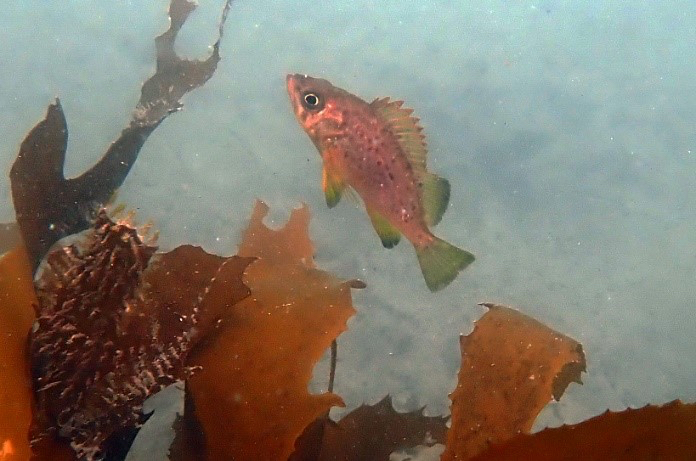
Japanese red seaperch fry growing in the regenerated arame bed.    Source: Kajima Corp.

“Algae in different regions have different characteristics, but if we understand the characteristics of each, we can deal with them,” Lim Boon Keng, a senior researcher at the institute, told J-Stories. “Large algae are distributed all over the world, and I hope that this technology can be applied worldwide.”
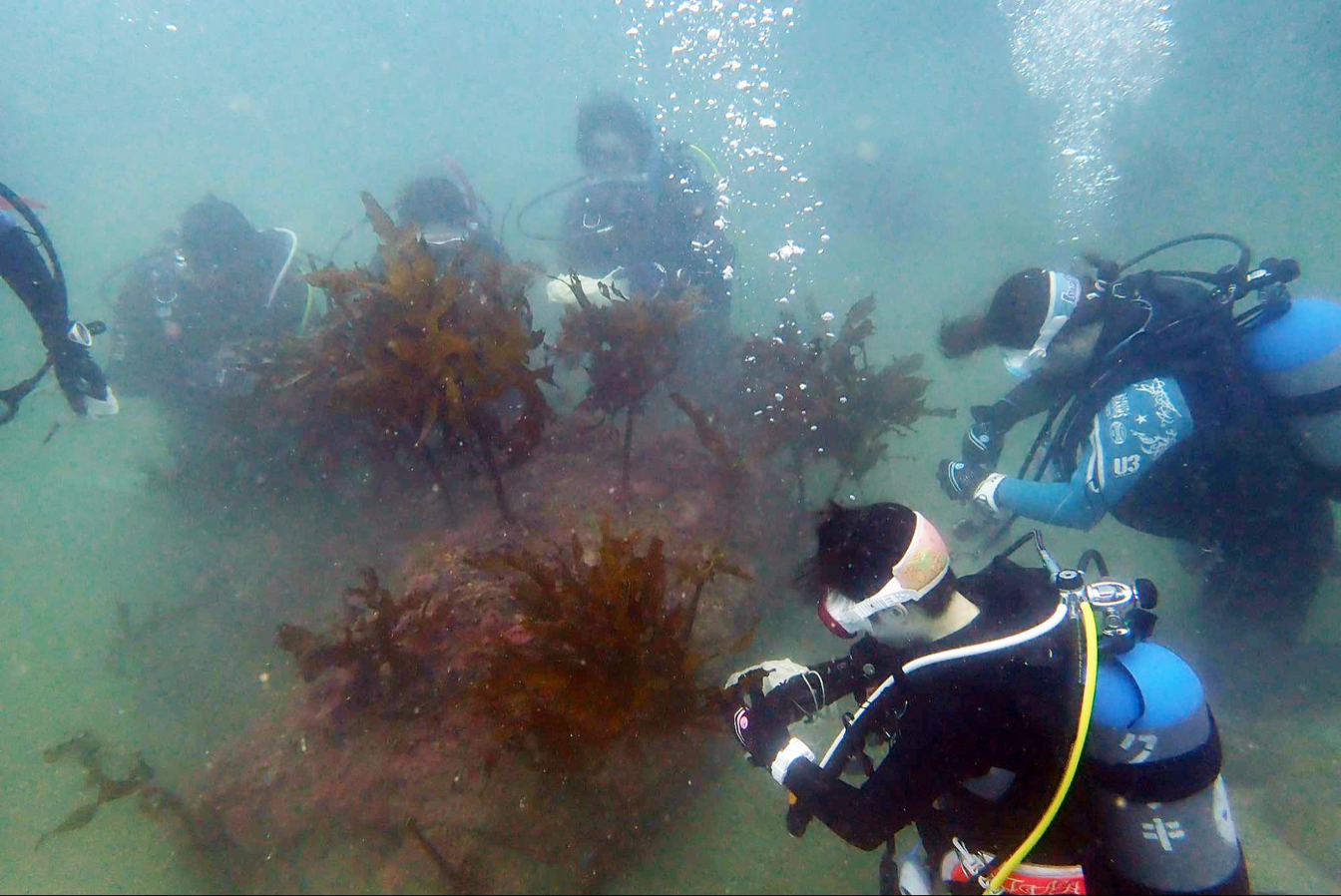
Checking on the regeneration of a kajime seaweed bed.    Source: Kajima Corp.

Other projects are underway across Japan. Since 2022, the Tokyo-based Japan Blue Carbon Project has been clearing seaweeds off the coast of the west port in Kushiro, Hokkaido, in order to encourage kelp growth. This May it announced an initiative to create a kelp seaweed bed together with Kushiro Gas and is now conducting demonstration experiments. Kelp is also a fish spawning ground, so the project is expected to boost the local fishing industry.
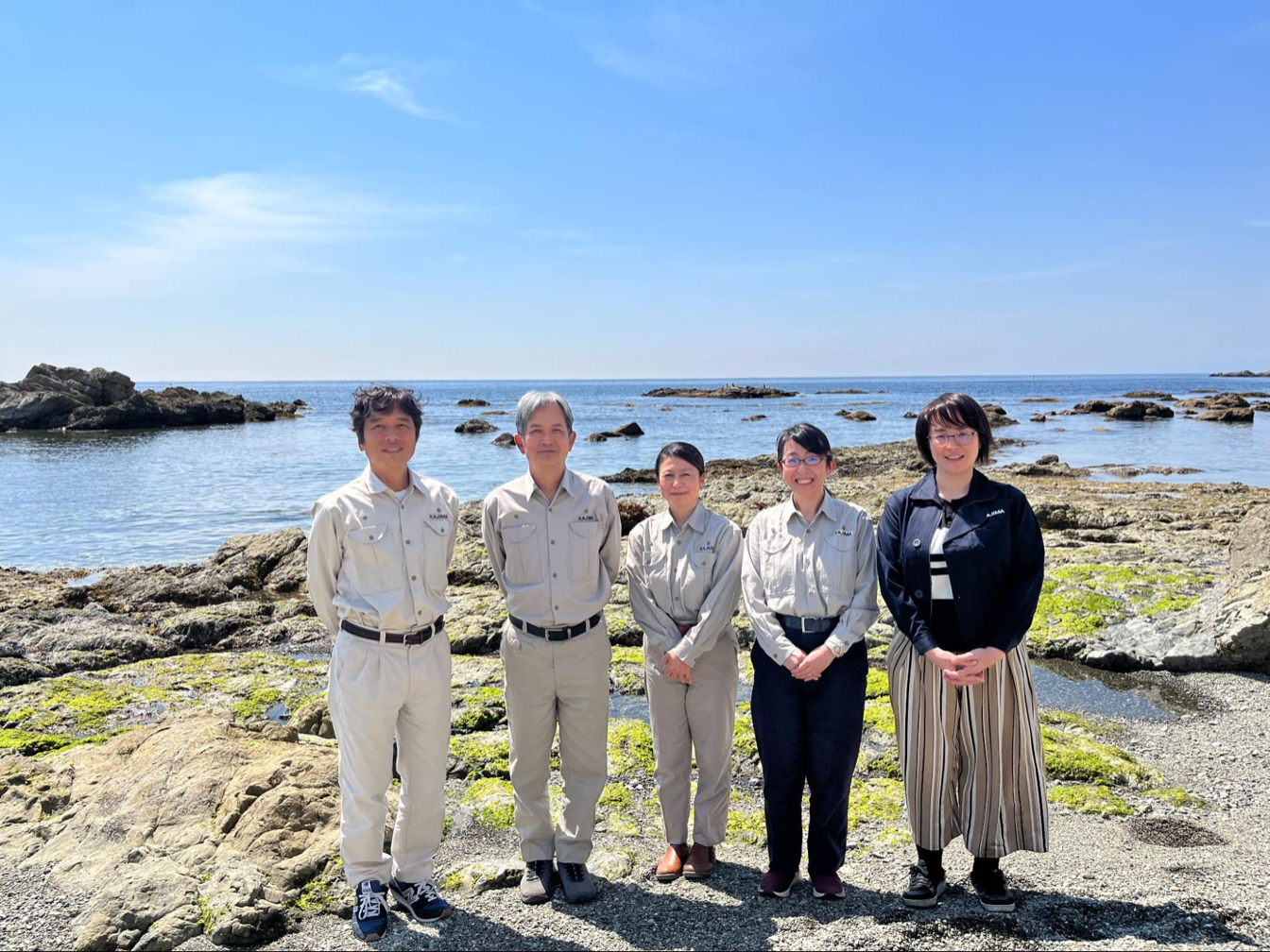
Lim Boon Keng (second from left) and other members of the Hayama Aquatic Environment Experimental Station at Sagami Bay, Kanagawa Pref.    Source: Kajima Corporation

Meanwhile, The J-Blue Credit system of voluntary carbon credits run by the Japan Blue Economy Association is similar to the government-run J-Credit system for forest conservation. The number of private companies issuing and purchasing these credits is rapidly increasing.

“Personally, I feel that blue carbon activities will become an even bigger movement in five to 10 years,” said Lim Boon Keng, whose project to restore eelgrass beds is a member of the association and has obtained J-Blue Credit certification. “I would like to further improve our technology before then.”

Translation by Tony McNicol

Top page photo by Kajima Corporation

For inquiries about this article, please contact jstories@pacificbridge.jp


.

Tags: AlgaecarbonclimateClimate Changegreen energyJapanresearchseeweedSustainability
Previous Post

Preserving heritage and combating fast fashion – A centuries-old craft envisions a sustainable future for clothing Industry

Next Post

Tea leaves’ second life: Ito En’s sustainable legacy

Ayaka Sagasaki

Ayaka Sagasaki

Related Posts

An innovation bridge across the Pacific: Japan and Latin America convene in Tokyo this August
Growth Support

An innovation bridge across the Pacific: Japan and Latin America convene in Tokyo this August

by Toshi Maeda
05/22/2026
AQUIVIO
Pitch

AQUIVIO

by Jstories
05/01/2026
BioTech

Evolutionary artificial protein slated for market debut as early as June 2026

by Yoshiko Ohira
04/17/2026
Ai Heart Japan
Pitch

Ai Heart Japan

by Jstories
04/01/2026
AssistMotion Inc.
Pitch

AssistMotion Inc.

by Jstories
04/01/2026
Next Post

Tea leaves' second life: Ito En's sustainable legacy

Leave a Reply Cancel reply

Your email address will not be published. Required fields are marked *

Trending

Greening the desert with trash

by Yui Sawada
03/23/2023
0

KYOTO (JStories) - The sight of local Niger women throwing kitchen waste out into the African desert inspired a project...

World’s first ‘teething drug’ clinical trial starts in September – Aiming for full commercialization by 2030

by Ruriko Kokubun
06/07/2024
0

Editor's Note: This article has been updated with new information. It was originally published on 09/22/2023. J-STORIES - The conventional...

The world’s first drug that helps patients ‘grow new teeth’

by Ruiko Kokubun
09/22/2023
0

KYOTO (JStories) - The conventional way to help people who have lost teeth due to tooth decay or aging has...

Japanese startup Neron develops gut bacteria ‘cocktail’ to ease stress and support mental health

by Kei Mizuno
05/11/2026
0

JStories — The gut is often called the body's "second brain" because it can function  independently while remaining in constant...

INTERVIEW | How Japanese musician Grover turned his passion of ‘sound’ into a health-tech startup

by Toshi Maeda
05/02/2025
0

JStories ー For over two decades, Yoshikazu Grover — better known simply as Grover — has been a familiar voice...

JStories

©Articles and photos published on JStories are protected by Japanese copyright law and international treaties. They cannot be reproduced without the permission of the copyright holders

Explore JStories

  • TOP STORIES
  • About JStories
  • Company
  • Team
  • Contact
  • Privacy Policy
  • Partner Press Releases

Follow Us

Welcome Back!

Login to your account below

Forgotten Password?

Retrieve your password

Please enter your username or email address to reset your password.

Log In
No Result
View All Result
  • TOP STORIES
  • AI
    • Artificial Intelligence
    • Robotics
    • Mobility
    • FinTech
    • Quantum
  • Earth
    • AgriTech
    • Green Innovation
    • Disaster Tech
    • SpaceTech
    • Materials
  • Life Sciences
    • BioTech
    • HealthTech
    • MedTech
    • AgeTech
  • Society
    • Media
    • EdTech
    • Diversity
    • FemTech
    • Social Impact
  • Lifestyle
    • FoodTech
    • Beauty & Fashion
    • Wellbeing
    • Arts & Music
    • Anime
  • Travel
    • Adventure Travel
    • Luxury Travel
    • Wellness & Medical Tourism
    • Culture
  • Video
  • Deals
    • Venture Capital
    • M&A
    • Events
    • Growth Support
    • Legal & IP
  • Interview
  • Opinion

©Articles and photos published on JStories are protected by Japanese copyright law and international treaties. They cannot be reproduced without the permission of the copyright holders

Are you sure want to unlock this post?
Unlock left : 0
Are you sure want to cancel subscription?