



• Login
Upgrade
JStories
  • 日本語
  • 繁体字中文
No Result
View All Result
  • Home
  • AI
    • Artificial Intelligence
    • Robotics
    • Mobility
    • FinTech
    • Quantum
  • Earth
    • AgriTech
    • Green Innovation
    • Disaster Tech
    • SpaceTech
    • Materials
  • Life Sciences
    • BioTech
    • HealthTech
    • MedTech
    • AgeTech
  • Society
    • Media
    • EdTech
    • Diversity
    • FemTech
    • Social Impact
  • Lifestyle
    • FoodTech
    • Beauty & Fashion
    • Wellbeing
    • Arts & Music
    • Anime
  • Travel
    • Adventure Travel
    • Luxury Travel
    • Wellness & Medical Tourism
    • Culture
  • Video
  • Deals
    • Venture Capital
    • M&A
    • Events
    • Pitch
    • Growth Support
    • Legal & IP
  • Interview
  • Opinion
  • Home
  • AI
    • Artificial Intelligence
    • Robotics
    • Mobility
    • FinTech
    • Quantum
  • Earth
    • AgriTech
    • Green Innovation
    • Disaster Tech
    • SpaceTech
    • Materials
  • Life Sciences
    • BioTech
    • HealthTech
    • MedTech
    • AgeTech
  • Society
    • Media
    • EdTech
    • Diversity
    • FemTech
    • Social Impact
  • Lifestyle
    • FoodTech
    • Beauty & Fashion
    • Wellbeing
    • Arts & Music
    • Anime
  • Travel
    • Adventure Travel
    • Luxury Travel
    • Wellness & Medical Tourism
    • Culture
  • Video
  • Deals
    • Venture Capital
    • M&A
    • Events
    • Pitch
    • Growth Support
    • Legal & IP
  • Interview
  • Opinion
en English ja 日本語 zh 繁体字中文
JStories
No Result
View All Result

Japan’s first surgical robot

Ayaka Sagasaki by Ayaka Sagasaki
02/08/2023
in AI, Life Sciences, MedTech, News, Robotics
0
Home AI
Share on FacebookShare on Twitter

J-STORIES – Surgical robots are wielding the scalpel more and more often these days. However, they don’t yet perform procedures autonomously. Rather, these devices that can make surgery safer and speed recovery are controlled by a human surgeon, usually a short distance away in the same room.

“Hinotori,” the first surgical robot in Japan to gain official approval, started performing urological procedures in 2020, and since last year has been also used for gastroenterological and gynecological operations. It is currently available at 31 medical facilities and has helped 900 patients. Those numbers are expected to rise as use of the robot expands to respiratory and other surgeries.

During robot-assisted surgery, small incisions are made into the patient’s body before a robotic arm tipped with instruments and an endoscope is inserted. The arm is remotely controlled by a surgeon sitting nearby in a “cockpit.” The method is similar to conventional laparoscopy (keyhole surgery) but the robotic arm can move more precisely and with more freedom. Also, there is less bleeding and a shorter recovery time compared to open surgery.

Prior to Hinotori, the world’s only surgical robot was the Da Vinci Surgical System. This went on sale in the United States in 1999 and has been used in large Japanese hospitals since 2009. According to the website of its developer, Intuitive Surgical, it has performed 8.5 million surgeries in 67 countries. However, many of the major patents for the system expired in 2019 and new robots have been under development in many countries since.
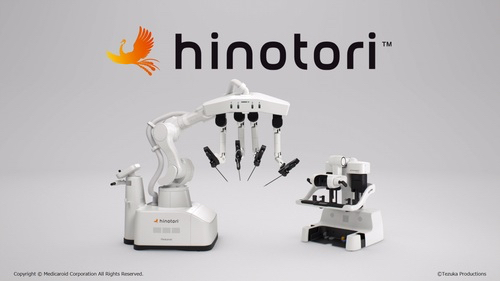
The Hinotori system is smaller than Da Vinci and well suited to compact spaces.     Source: Medicaroid

Hinotori was developed by Medicaroid, a company based in the central Japan city of Kobe and established in 2013 with investment from industrial robot manufacturer Kawasaki Heavy Industries and Sysmex, a maker of testing equipment and reagents. The Hinotori robot is named after a manga by Osamu Tezuka, a legendary Japanese manga artist who was also a licensed physician.

According to Medicaroid, they developed Hinotori to meet “the need for a Japanese robot that could perform the delicate manual techniques of Japanese surgeons.” They worked with various local doctors to produce a compact, humanlike, robotic arm capable of smooth movements. The cockpit can also be adjusted to the body shape and posture of the surgeon, making long periods of use more comfortable.
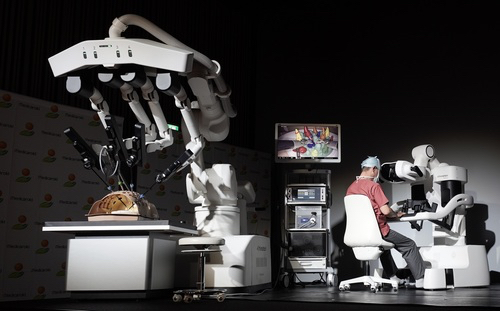
The surgeon operates the robot from a “cockpit” a short distance away from the patient.     Source: Medicaroid

The system also collects data during operations, so that if a problem occurs, a support center can investigate the cause and solve problems in real time. This feedback accumulates over time and is used to update the system with new functions. Medicaroid is also looking into building a database with such information to train young doctors.

There are hopes that remote robotic surgery could help address problems with shortages of such medical care in the Japanese countryside. Advanced medical techniques and equipment tend to be concentrated in cities, but a possible solution would be for highly skilled doctors to operate on patients using remote systems.

According to Medicaroid, their system might also be able to help in the training of young doctors through remote assistance by veteran doctors. To this end, the company has been working on several remote surgery projects with universities and other companies.

Medicaroid also hopes to sell its system abroad and has set up operations in Silicon Valley, Germany, and Singapore. Since many doctors in Asia have similar body shapes to Japanese doctors, the company hopes to focus on those markets first.

Translation by Tony McNicol

Top page photo by Medicaroid

For inquiries about this article, please contact jstories@pacficbridge.jp


.

Tags: HealthJapan roboticsLivingTechnology
Previous Post

Envisioning Japan’s “green metropolis” around Mount Fuji

Next Post

Promoting medical innovation

Ayaka Sagasaki

Ayaka Sagasaki

Related Posts

ディープテックとAI、地球課題に挑む新興10社の「実装力」
Artificial Intelligence

Deep Tech and AI: 10 Startups Tackling Global Challenges With Market Execution

by JStories Editorial Team
09/15/2026
Japan looks to Latin America for the minerals powering AI — and the IDB offers to be the bridge
Deals

Japan looks to Latin America for the minerals powering AI — and the IDB offers to be the bridge

by Toshi Maeda
08/29/2026
What matters is not what you build, but who you build it with
Events

What matters is not what you build, but who you build it with

by Ikeda Masaru
08/28/2026
Taiwan’s startups get a Kansai front door — and it swings both ways
Events

Taiwan’s startups get a Kansai front door — and it swings both ways

by Toshi Maeda
08/27/2026
台湾スタートアップ 46社中30社超が、すでに日本に進出 〜 2026 日台イノベーション・サミット
Deals

The introductions are over: Taiwan’s startups are already in Japan

by Ikeda Masaru
08/26/2026
Next Post

Promoting medical innovation

Leave a Reply Cancel reply

Your email address will not be published. Required fields are marked *

Trending

Greening the desert with trash

by Yui Sawada
03/23/2023
0

KYOTO (JStories) - The sight of local Niger women throwing kitchen waste out into the African desert inspired a project...

Japan looks to Latin America for the minerals powering AI — and the IDB offers to be the bridge

Japan looks to Latin America for the minerals powering AI — and the IDB offers to be the bridge

by Toshi Maeda
08/29/2026
0

TOKYO — Japan's search for stable supplies of lithium, copper and rare earths — the raw materials behind electric vehicles,...

What matters is not what you build, but who you build it with

What matters is not what you build, but who you build it with

by Ikeda Masaru
08/28/2026
0

Tokyo  - The event that once introduced Taiwanese startups to Japan has changed its role over five years. The biggest...

Eco-friendly next-generation laundromat that doesn’t use detergent

by Riku Kobayashi
11/10/2023
0

J-STORIES - Laundry drainage is said to account for 10% of all domestic wastewater. A Japanese startup has developed a...

Taiwan’s startups get a Kansai front door — and it swings both ways

Taiwan’s startups get a Kansai front door — and it swings both ways

by Toshi Maeda
08/27/2026
0

OSAKA — Taiwanese startups have visited Kansai for years. What they have not had is a door with a handle...

JStories

©Articles and photos published on JStories are protected by Japanese copyright law and international treaties. They cannot be reproduced without the permission of the copyright holders

Explore JStories

  • Home
  • About JStories
  • JStories Newsletter Sign-Up
  • Company
  • Team
  • Contact
  • Privacy Policy
  • Partner Press Releases

Follow Us

Welcome Back!

Login to your account below

Forgotten Password?

Retrieve your password

Please enter your username or email address to reset your password.

Log In
No Result
View All Result
  • TOP STORIES
  • AI
    • Artificial Intelligence
    • Robotics
    • Mobility
    • FinTech
    • Quantum
  • Earth
    • AgriTech
    • Green Innovation
    • Disaster Tech
    • SpaceTech
    • Materials
  • Life Sciences
    • BioTech
    • HealthTech
    • MedTech
    • AgeTech
  • Society
    • Media
    • EdTech
    • Diversity
    • FemTech
    • Social Impact
  • Lifestyle
    • FoodTech
    • Beauty & Fashion
    • Wellbeing
    • Arts & Music
    • Anime
  • Travel
    • Adventure Travel
    • Luxury Travel
    • Wellness & Medical Tourism
    • Culture
  • Video
  • Deals
    • Venture Capital
    • M&A
    • Events
    • Growth Support
    • Legal & IP
  • Interview
  • Opinion

©Articles and photos published on JStories are protected by Japanese copyright law and international treaties. They cannot be reproduced without the permission of the copyright holders

Not enough quota to unlock this post
Unlock left : 0
Are you sure want to cancel subscription?