
• Login
Upgrade
JStories
  • 日本語
  • 中文 (中国)
No Result
View All Result
  • Home
  • AI
    • Artificial Intelligence
    • Robotics
    • Mobility
    • FinTech
    • Quantum
  • Earth
    • AgriTech
    • Green Innovation
    • Disaster Tech
    • SpaceTech
    • Materials
  • Life Sciences
    • BioTech
    • HealthTech
    • MedTech
    • AgeTech
  • Society
    • Media
    • EdTech
    • Diversity
    • FemTech
    • Social Impact
  • Lifestyle
    • FoodTech
    • Beauty & Fashion
    • Wellbeing
    • Arts & Music
    • Anime
  • Travel
    • Adventure Travel
    • Luxury Travel
    • Wellness & Medical Tourism
    • Culture
  • Video
  • Deals
    • Venture Capital
    • M&A
    • Events
    • Pitch
    • Growth Support
    • Legal & IP
  • Interview
  • Opinion
  • Home
  • AI
    • Artificial Intelligence
    • Robotics
    • Mobility
    • FinTech
    • Quantum
  • Earth
    • AgriTech
    • Green Innovation
    • Disaster Tech
    • SpaceTech
    • Materials
  • Life Sciences
    • BioTech
    • HealthTech
    • MedTech
    • AgeTech
  • Society
    • Media
    • EdTech
    • Diversity
    • FemTech
    • Social Impact
  • Lifestyle
    • FoodTech
    • Beauty & Fashion
    • Wellbeing
    • Arts & Music
    • Anime
  • Travel
    • Adventure Travel
    • Luxury Travel
    • Wellness & Medical Tourism
    • Culture
  • Video
  • Deals
    • Venture Capital
    • M&A
    • Events
    • Pitch
    • Growth Support
    • Legal & IP
  • Interview
  • Opinion
en English ja 日本語 zh 中文 (中国)
JStories
No Result
View All Result

Concrete solutions: Self-healing concrete to solve building problems

Japanese material technology is set to revolutionize the industry and reduce carbon footprint

Yui Sawada by Yui Sawada
02/02/2024
in AI, Disaster Tech, Earth, Green Innovation, News, Web3/Blockchain
0
Home AI
Share on FacebookShare on Twitter

J-STORIES – Japan’s big construction woes may be solved by a small, unexpected solution: bacteria. This special microorganism enables the self-healing properties of a concrete developed by the Japanese company Aizawa Concrete Corporation. The material is set to address the building issues in Japan and to reduce the carbon emissions affecting the industry.

Japan saw a rapid construction boom during its economic growth in the 1960s-70s. But the now 50- to 60-year-old buildings are now at their durability limit as the concrete used is already old and cracked. If left unattended, these will increase the risk of the steel rebar getting rust, which can lead to collapse. The repair and maintenance of said buildings are labor-intensive and costly.

Here comes the Basilisk HA self-healing concrete and its wunder-bacteria. When a crack appears, the bacteria immediately fill it. Because it activates at the early stages of the crack, undetected during inspections, it can repair the concrete before it worsens.
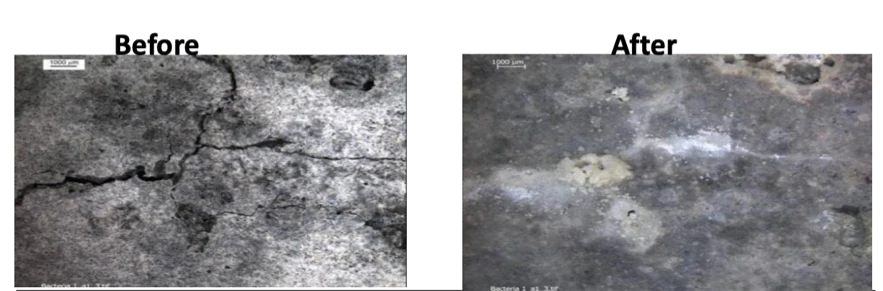
The self-healing concrete in action     Source: Aizawa Concrete Corp.

The concrete bacteria

The bacteria can live up to 200 years and reproduce by division repeatedly, thus the healing properties can last a long time. The concrete is expected to have a service life of 100 years and more, thus allowing the structure to be de facto “permanent.”
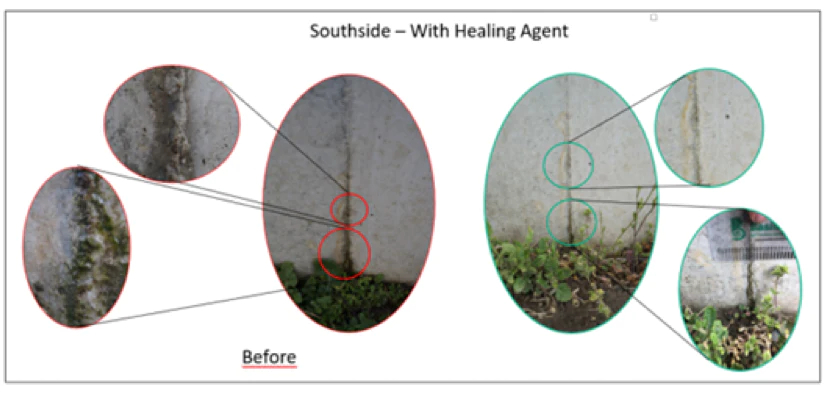
Before (L) and after (R) the addition of self-healing concrete     Source: Aizawa Concrete Corp.

The technology was originally developed by a Dutch team led by Associate Professor Hendrik M. Jonckers of Delft University of Technology. However, the production process was complicated, and the practical and commercial application was challenging.

Aizawa Concrete Corporation tie-up with the Dutch side. They spent 2.5 years developing a production method and conducting tests. Eventually, they succeeded in commercializing and mass-producing a concrete suitable for Japan’s environment.

The concrete is also sold as a mortar and liquid repair material. The technology has been used in construction facilities in Japan, which include Japan’s largest onshore salmon aquaculture facility, a tsunami-proof foundation for gas piping in an LNG terminal, and several large pond-like structures.
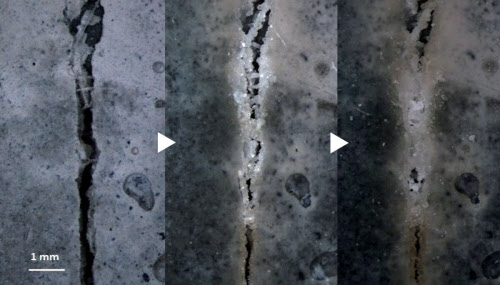
Repairing cracks in two months. From L to R: at the time of crack, after 24 days; after 58 days     Source: Aizawa Concrete Corp.

From healing itself to reducing carbon

Aizawa’s self-healing concrete is attracting attention as one way to reduce CO2 emissions in the construction industry. Because the concrete can technically repair itself, it can reduce repair and reconstruction activities, which emit a lot of CO2.

To spread their decarbonization goal to the entire industry, the company launched in January 2022 their “NET ZERO 2035” goal. They plan to achieve virtually zero CO2 emissions in their product supply chains, suppliers, logistics, and recycling processes by 2035, the company’s 100th anniversary.
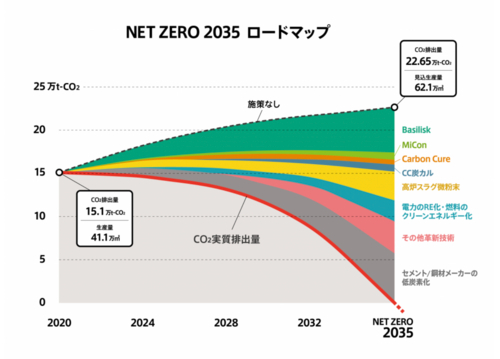
NET ZERO 2035 roadmap     Source: Aizawa Concrete Corp.

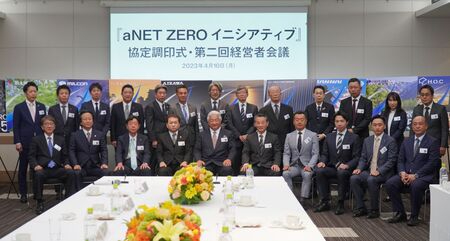
To achieve their goal, Aizawa announced the “aNET ZERO Initiative,” a comprehensive technology transfer program for other companies that wish to join their cause. This transfer includes the company’s proprietary material decarbonization technology and greenhouse gas emissions management using blockchain. The targeted supply chain includes companies both in Japan and overseas. The company has formed partnerships with 46 companies, who are accelerating a “collective move” toward decarbonization in the industry.
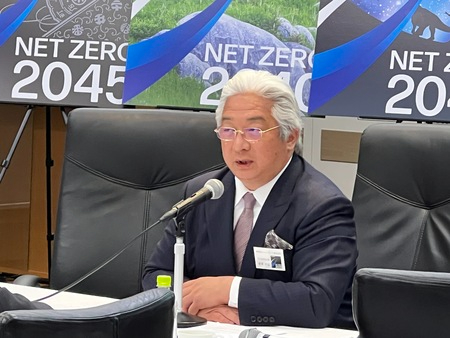
CEO Yoshihiro Aizawa      Source: Aizawa Concrete Corp.
Signing ceremony for the aNET ZERO initiative agreement and the second management meeting     Source: Aizawa Concrete Corp.

In an interview with J-STORIES, company president Yoshihiro Aizawa explained the significance of this action:

“We thought it was our responsibility to take action before anyone else, as we are the first ones to be aware of this problem. By sending this message to many people and building connections with those who have the same goals, the world will surely change little by little.” He also hopes the cement and concrete industry will become “an indispensable industry in the era of decarbonization.”

Translation and Editing by Dedsiderio Luna.

Top page photo by Aizawa Concrete Corp.

For inquires about this article, please contact us at jstories@pacificbridge.jp


.

Tags: Aizawa ConcreteaNET ZERO InitiativeBacteriaBasilisk HAblockchaincarbon neutralitycircular economydecarbonizationDelft University of TechnologyInfrastructure MaintenanceJapan TechNET ZERO 2035Self-healing ConcreteSustainability
Previous Post

Petcare AI: Predicting pet health through facial recognition

Next Post

Dawn of the humanoid: China’s bold stride in robot innovation

Yui Sawada

Yui Sawada

Related Posts

One typhoon, four warning systems: Japanese AI stitches the disaster picture together
Disaster Tech

One typhoon, four warning systems: Japanese AI stitches the disaster picture together

by JStories Editorial Team
07/15/2026
As Venezuela’s quake cuts off water, a Japanese recycler shows another way
Disaster Tech

As Venezuela’s quake cuts off water, a Japanese recycler shows another way

by JStories Editorial Team
07/10/2026
日本の温泉郷に眠る地熱発電、AIデータセンターの電力源として新たな期待
Earth

Geothermal Power Taps a ‘Buried Treasure’ to Revitalize a Hot Spring Region

by Yoshiko Ohira
07/08/2026
As deepfake scams spread, a Japanese institute builds detectors to catch them
Artificial Intelligence

As deepfake scams spread, a Japanese institute builds detectors to catch them

by JStories Editorial Team
07/03/2026
Sony’s neck-worn cooler targets a world running short on ways to beat the heat
Green Innovation

Sony’s neck-worn cooler targets a world running short on ways to beat the heat

by JStories Editorial Team
07/01/2026
Next Post

Dawn of the humanoid: China's bold stride in robot innovation

Leave a Reply Cancel reply

Your email address will not be published. Required fields are marked *

Trending

Greening the desert with trash

by Yui Sawada
03/23/2023
0

KYOTO (JStories) - The sight of local Niger women throwing kitchen waste out into the African desert inspired a project...

The world’s first drug that helps patients ‘grow new teeth’

by Ruiko Kokubun
09/22/2023
0

KYOTO (JStories) - The conventional way to help people who have lost teeth due to tooth decay or aging has...

Evolutionary artificial protein slated for market debut as early as June 2026

by Yoshiko Ohira
04/17/2026
0

JStories — Severe and hard-to-heal wounds — such as those caused by burns, injuries, pressure ulcers, skin cancer surgery, and...

Ai Heart Japan

Ai Heart Japan

by Jstories
06/18/2024
0

https://www.youtube.com/watch?v=q0fmsRv3ZjQ Company Profile Startup Name: Ai Heart Japan Co., Ltd. Stage: Early-stage (founded March 30, 2021) Location: Japan Website: https://ai-heart.jp/...

AssistMotion Inc.

AssistMotion Inc.

by Jstories
06/18/2024
0

https://www.youtube.com/watch?v=xQrw2hrDzzc Pitch by the representative director of AssistMotion Minoru Hashimoto Company Profile Startup Name: AssistMotion Inc. Stage: Early-stage / Seed...

JStories

©Articles and photos published on JStories are protected by Japanese copyright law and international treaties. They cannot be reproduced without the permission of the copyright holders

Explore JStories

  • Home
  • About JStories
  • JStories Newsletter Sign-Up
  • Company
  • Team
  • Contact
  • Privacy Policy
  • Partner Press Releases

Follow Us

Welcome Back!

Login to your account below

Forgotten Password?

Retrieve your password

Please enter your username or email address to reset your password.

Log In
No Result
View All Result
  • TOP STORIES
  • AI
    • Artificial Intelligence
    • Robotics
    • Mobility
    • FinTech
    • Quantum
  • Earth
    • AgriTech
    • Green Innovation
    • Disaster Tech
    • SpaceTech
    • Materials
  • Life Sciences
    • BioTech
    • HealthTech
    • MedTech
    • AgeTech
  • Society
    • Media
    • EdTech
    • Diversity
    • FemTech
    • Social Impact
  • Lifestyle
    • FoodTech
    • Beauty & Fashion
    • Wellbeing
    • Arts & Music
    • Anime
  • Travel
    • Adventure Travel
    • Luxury Travel
    • Wellness & Medical Tourism
    • Culture
  • Video
  • Deals
    • Venture Capital
    • M&A
    • Events
    • Growth Support
    • Legal & IP
  • Interview
  • Opinion

©Articles and photos published on JStories are protected by Japanese copyright law and international treaties. They cannot be reproduced without the permission of the copyright holders

Not enough quota to unlock this post
Unlock left : 0
Are you sure want to cancel subscription?