
• Login
Upgrade
JStories
  • 日本語
  • 繁体字中文
No Result
View All Result
  • Home
  • AI
    • Artificial Intelligence
    • Robotics
    • Mobility
    • FinTech
    • Quantum
  • Earth
    • AgriTech
    • Green Innovation
    • Disaster Tech
    • SpaceTech
    • Materials
  • Life Sciences
    • BioTech
    • HealthTech
    • MedTech
    • AgeTech
  • Society
    • Media
    • EdTech
    • Diversity
    • FemTech
    • Social Impact
  • Lifestyle
    • FoodTech
    • Beauty & Fashion
    • Wellbeing
    • Arts & Music
    • Anime
  • Travel
    • Adventure Travel
    • Luxury Travel
    • Wellness & Medical Tourism
    • Culture
  • Video
  • Deals
    • Venture Capital
    • M&A
    • Events
    • Pitch
    • Growth Support
    • Legal & IP
  • Interview
  • Opinion
  • Home
  • AI
    • Artificial Intelligence
    • Robotics
    • Mobility
    • FinTech
    • Quantum
  • Earth
    • AgriTech
    • Green Innovation
    • Disaster Tech
    • SpaceTech
    • Materials
  • Life Sciences
    • BioTech
    • HealthTech
    • MedTech
    • AgeTech
  • Society
    • Media
    • EdTech
    • Diversity
    • FemTech
    • Social Impact
  • Lifestyle
    • FoodTech
    • Beauty & Fashion
    • Wellbeing
    • Arts & Music
    • Anime
  • Travel
    • Adventure Travel
    • Luxury Travel
    • Wellness & Medical Tourism
    • Culture
  • Video
  • Deals
    • Venture Capital
    • M&A
    • Events
    • Pitch
    • Growth Support
    • Legal & IP
  • Interview
  • Opinion
en English ja 日本語 zh 繁体字中文
JStories
No Result
View All Result

Japan’s bendable solar film reaches data centers as AI strains the grid

As AI's power demand pushes grids to the brink, Japan is putting flexible perovskite solar onto the walls of the very buildings driving the surge.

Toshi Maeda by Toshi Maeda
06/08/2026
in Green Innovation, AI, Artificial Intelligence, Earth, News
0
Home Earth Green Innovation
Share on FacebookShare on Twitter

PROBLEM: AI’s surging, around-the-clock electricity demand is straining power grids worldwide, prompting fresh government action and rare reliability warnings. Meanwhile crowded data centers have no room for conventional silicon solar panels.
SOLUTION: Japan’s flexible, film-type perovskite solar cells, now being installed on data centers and offices, allowing buildings to make clean power on walls and surfaces that rigid panels cannot use.

JStories — Japan’s bendable solar film reaches data centers as AI strains the grid

As AI’s power demand pushes grids to the brink, Japan is putting flexible perovskite solar onto the walls of the very buildings driving the surge.

Light, bendable, and installable on walls and curved surfaces where rigid panels cannot go. Film-type perovskite solar cells are arriving on Japanese data centers and offices just as artificial intelligence’s around-the-clock electricity appetite triggers fresh warnings from grid operators worldwide.
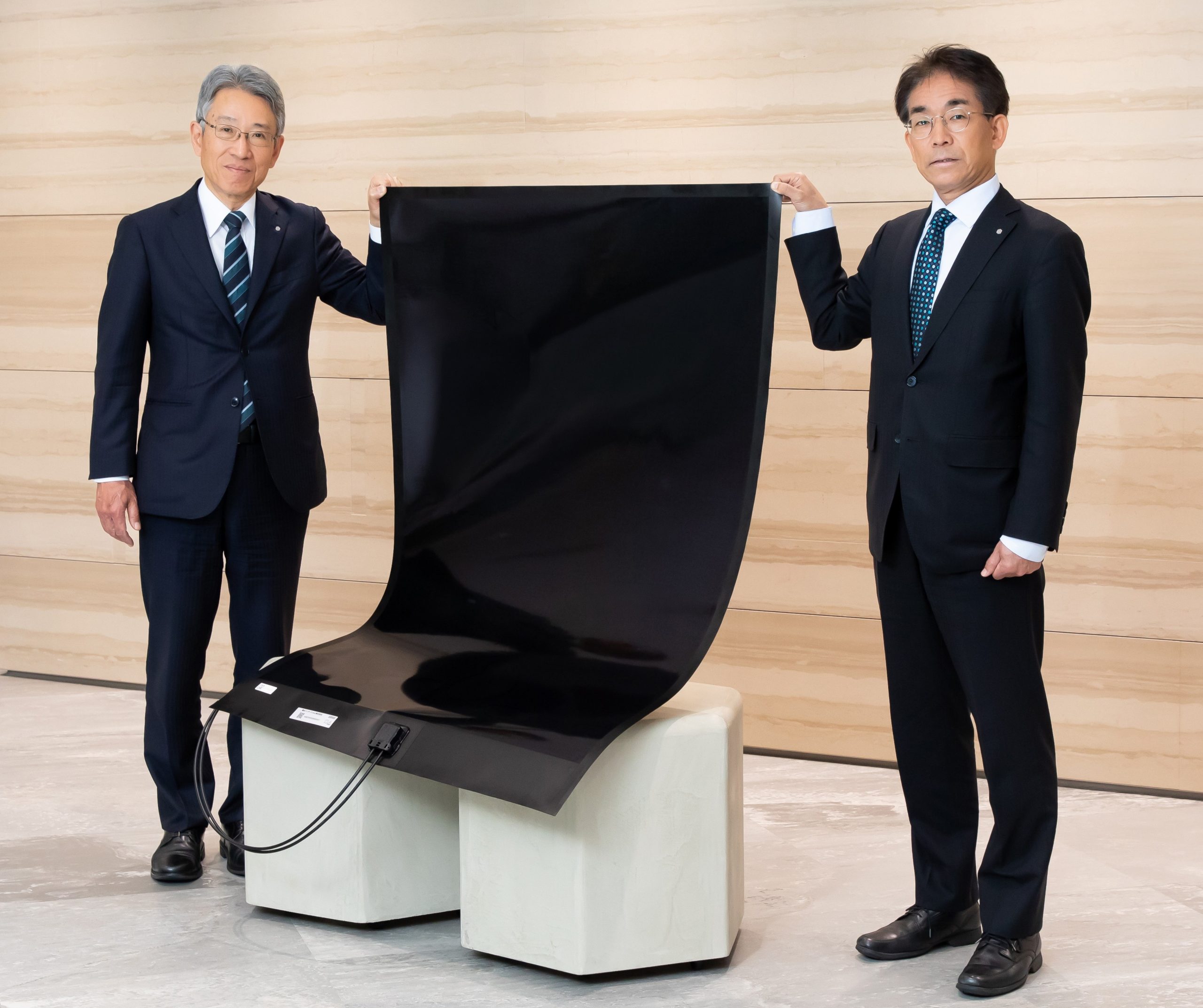
Sekisui Solar Film Co., Ltd. President & CEO: Futoshi Uewaki (Left) & Sekisui Chemical Co., Ltd. President & CEO: Ikusuke Shimizu (Right) presenting their film-type perovskite solar cells called “Solafil” Source: Sekisui Chemical

AI’s power hunger forces a rethink of where solar can go

The strain that artificial intelligence is placing on the world’s power grids drew another official response this week. The U.S. Department of Energy launched a platform called Agora to simulate how hyperscale AI data centers affect grid stability, describing them as volatile, high-density power loads. It follows a rare, high-level reliability warning from North America’s grid monitor about risks from large data centers, as AI’s demand for nonstop power continues to outpace supply.

One partial answer is taking shape in Japan. Sekisui Chemical, an Osaka-based manufacturer, launched its “Solafil” film-type perovskite solar business in March 2026. Together with NTT Data, it has begun installing the film with plans to expand to 16 data centers and offices from fiscal 2026. The company is targeting 100 megawatts of annual output by 2027 and gigawatt-scale production by 2030.

The core appeal is simple: because the film is flexible and lightweight, it can be mounted on building walls and other surfaces that conventional silicon panels cannot reach. Sekisui frames this as a way to add renewable power in space-constrained cities. Thus transforming the existing buildings into quiet generators which require no new land.

From pilots to industrial scale — but limitations remain

The technology is crossing from pilot to industrial scale, though Japan’s mass production volumes will remain modest until Sekisui’s commercial line ramps up in 2027. Globally, China’s UtmoLight is already running a fully operational one-gigawatt perovskite line, and UK-based Oxford PV has shipped its first modules to U.S. utilities. Cost estimates currently put manufacturing near $0.57 per watt, with projections falling to $0.29–0.42 at full scale.

Japan’s approach is distinct. Rather than competing on volume, the country is betting on flexible film for surfaces, walls, and curved structures, rather than utility-scale fields. Sekisui has committed approximately ¥90 billion through 2030, and Japan’s Ministry of Economy, Trade and Industry has awarded ¥24.6 billion to Panasonic, Ricoh, and EneCoat for related development.

Perovskite film is not without its challenges, however. It still trails conventional silicon solar in durability, degrading faster under heat, moisture, and UV exposure, and long-term outdoor performance data remains limited. Most formulations contain lead, raising questions around toxicity and disposal. Flexible film is also lower in efficiency and power density than rigid panels, meaning it complements rather than replaces conventional solar. Perovskite film will not, on its own, power an AI data center.

But as data center operators scramble for every available source of electricity, the ability to turn their own walls into generators represents a meaningful, if modest, addition to the supply side of an increasingly strained equation.

For inquiries regarding this article, please contact jstories@pacificbridge.jp.

Previous Post

Japanese startup Impact Circle turns “impact” into a measurable yardstick for investors

Next Post

From surveying and agriculture to daily life and defense: Drones tackle society’s toughest challenges

Toshi Maeda

Toshi Maeda

A multilingual journalist with over 25 years of experience in the media industry, Maeda worked as a producer and correspondent for Reuters TV in Tokyo after stints as a reporter at The Japan Times, The Associated Press in San Francisco, Newsday in New York, and The Desert Sun in Palm Springs, California. Maeda has also taught journalism at Komazawa University’s Faculty of Global Media Studies. Currently, he serves as executive editor for solutions-focused bilingual news platform J-Stories, a PBMC media outlet.

Related Posts

ディープテックとAI、地球課題に挑む新興10社の「実装力」
Artificial Intelligence

Deep Tech and AI: 10 Startups Tackling Global Challenges With Market Execution

by JStories Editorial Team
09/15/2026
Japan looks to Latin America for the minerals powering AI — and the IDB offers to be the bridge
Deals

Japan looks to Latin America for the minerals powering AI — and the IDB offers to be the bridge

by Toshi Maeda
08/29/2026
What matters is not what you build, but who you build it with
Events

What matters is not what you build, but who you build it with

by Ikeda Masaru
08/28/2026
Taiwan’s startups get a Kansai front door — and it swings both ways
Events

Taiwan’s startups get a Kansai front door — and it swings both ways

by Toshi Maeda
08/27/2026
台湾スタートアップ 46社中30社超が、すでに日本に進出 〜 2026 日台イノベーション・サミット
Deals

The introductions are over: Taiwan’s startups are already in Japan

by Ikeda Masaru
08/26/2026
Next Post
測量、農業、インフラ点検から防衛まで、ドローンで社会課題を解決

From surveying and agriculture to daily life and defense: Drones tackle society's toughest challenges

Leave a Reply Cancel reply

Your email address will not be published. Required fields are marked *

Trending

Greening the desert with trash

by Yui Sawada
03/23/2023
0

KYOTO (JStories) - The sight of local Niger women throwing kitchen waste out into the African desert inspired a project...

Japan looks to Latin America for the minerals powering AI — and the IDB offers to be the bridge

Japan looks to Latin America for the minerals powering AI — and the IDB offers to be the bridge

by Toshi Maeda
08/29/2026
0

TOKYO — Japan's search for stable supplies of lithium, copper and rare earths — the raw materials behind electric vehicles,...

Eco-friendly next-generation laundromat that doesn’t use detergent

by Riku Kobayashi
11/10/2023
0

J-STORIES - Laundry drainage is said to account for 10% of all domestic wastewater. A Japanese startup has developed a...

What matters is not what you build, but who you build it with

What matters is not what you build, but who you build it with

by Ikeda Masaru
08/28/2026
0

Tokyo  - The event that once introduced Taiwanese startups to Japan has changed its role over five years. The biggest...

Taiwan’s startups get a Kansai front door — and it swings both ways

Taiwan’s startups get a Kansai front door — and it swings both ways

by Toshi Maeda
08/27/2026
0

OSAKA — Taiwanese startups have visited Kansai for years. What they have not had is a door with a handle...

JStories

©Articles and photos published on JStories are protected by Japanese copyright law and international treaties. They cannot be reproduced without the permission of the copyright holders

Explore JStories

  • Home
  • About JStories
  • JStories Newsletter Sign-Up
  • Company
  • Team
  • Contact
  • Privacy Policy
  • Partner Press Releases

Follow Us

Welcome Back!

Login to your account below

Forgotten Password?

Retrieve your password

Please enter your username or email address to reset your password.

Log In
No Result
View All Result
  • TOP STORIES
  • AI
    • Artificial Intelligence
    • Robotics
    • Mobility
    • FinTech
    • Quantum
  • Earth
    • AgriTech
    • Green Innovation
    • Disaster Tech
    • SpaceTech
    • Materials
  • Life Sciences
    • BioTech
    • HealthTech
    • MedTech
    • AgeTech
  • Society
    • Media
    • EdTech
    • Diversity
    • FemTech
    • Social Impact
  • Lifestyle
    • FoodTech
    • Beauty & Fashion
    • Wellbeing
    • Arts & Music
    • Anime
  • Travel
    • Adventure Travel
    • Luxury Travel
    • Wellness & Medical Tourism
    • Culture
  • Video
  • Deals
    • Venture Capital
    • M&A
    • Events
    • Growth Support
    • Legal & IP
  • Interview
  • Opinion

©Articles and photos published on JStories are protected by Japanese copyright law and international treaties. They cannot be reproduced without the permission of the copyright holders

Not enough quota to unlock this post
Unlock left : 0
Are you sure want to cancel subscription?