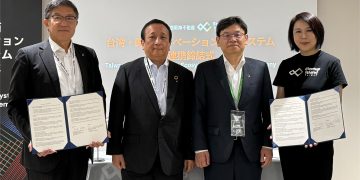


JStories — Terra Drone Corp., a Tokyo-based startup attracting international attention for its ties with Ukrainian firms developing combat-tested interceptor drones, is using drone technology to address social challenges in fields ranging from surveying, disaster recovery, infrastructure inspection and agriculture to defense.
The company, headquartered in Shibuya Ward and led by founder and CEO Toru Tokushige, is developing and deploying services aimed at addressing social problems around the world. In recent years, it has also stepped up efforts to build what it calls the “infrastructure of the sky” — systems needed to manage drone traffic safely at scale.
“Drones aren’t just a cutting-edge technology,” said Kazuhiro Ryu, an UTM Business Development manager.
JStories asked Ryu why Terra Drone sees drones not simply as technology, but as a means of solving social problems — and what kind of future the company is working toward.
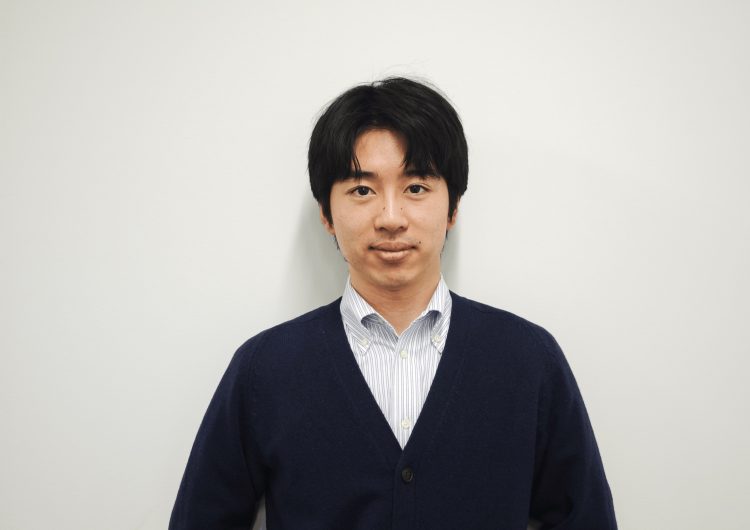
Kazuhiro Ryu, an UTM Business Development manager. Photo courtesy of Terra Drone
Taking on threats to everyday life
Terra Drone’s business falls into two broad areas: drone-based solutions and the traffic management systems that support them. The first develops drone technologies; the second builds the foundation needed to put those technologies to work safely in society.
“To make a future possible where countless drones share the sky, you need a system that manages flights safely and efficiently,” Ryu said. “The more aircraft there are, the higher the risk of collisions or crashes — and the more important it becomes to have a system that controls and coordinates flights in real time. That’s the infrastructure we’re trying to build.”
The company says drones can help address a range of social problems facing the world today. In Japan and many other regions, aging infrastructure, strained logistics networks and worsening labor shortages are becoming serious threats to daily life.
Inspections of water pipes, bridges and dams — dangerous work long handled by humans — are being affected by a shrinking workforce. Terra Drone has responded with services that deliver high-precision surveying in less time and allow hazardous sites to be surveyed safely. Its in-house UAV LiDAR system, Terra Lidar, is sold as both hardware and software and is used in services rolled out across 47 of Japan’s 47 prefectures.
Overseas, the company’s drones spray pesticides in countries such as Indonesia and Malaysia, improving efficiency as well as working conditions and contributing to more sustainable agriculture. In this way, drones are evolving beyond tools for improving efficiency into systems that can take over work people can no longer safely or easily perform.
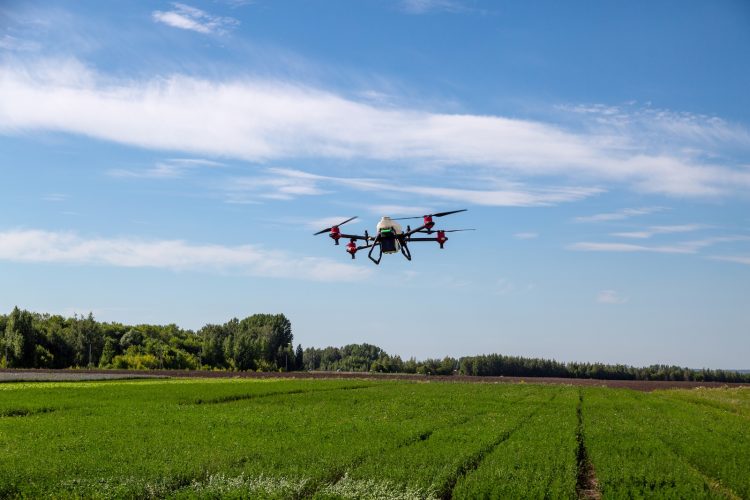
An agricultural drone flying over a field. (Image photo) Photo courtesy of Envato
Alongside its industrial drone business, Terra Drone announced this spring a series of capital and business alliances with two Ukrainian companies that develop and manufacture interceptor drones. The Japanese firm is deepening ties with Ukrainian companies that have accumulated expertise through actual combat against Russia. It is also moving quickly to mass-produce high-performance, low-cost interceptor drones, with Japan, Europe and other markets in mind.
In a press release announcing one of the deals, Tokushige said: “The exchange of UAVs seen in recent situations such as in the Middle East indicates that, in modern defense, securing defense drones that neutralize threats such as loitering munitions is a top priority for the security of the international community.”
He added that Terra Drone would “supply reliable solutions verified through partnerships with the two Ukrainian companies to the world, and contribute to international stability and stronger deterrence.”
A traffic system for the coming surge in drones
A major hurdle to wider drone use is operational constraint. The basic premise is that one operator controls one aircraft. That means simply adding more drones does not directly solve labor shortages.
That is where unmanned aircraft systems traffic management, or UTM, comes in. Enabling autonomous flight, simultaneous operation of multiple aircraft and beyond-visual-line-of-sight flight requires a system that can manage entire areas of airspace safely. UTM, Ryu said, is the digital infrastructure that makes that possible.
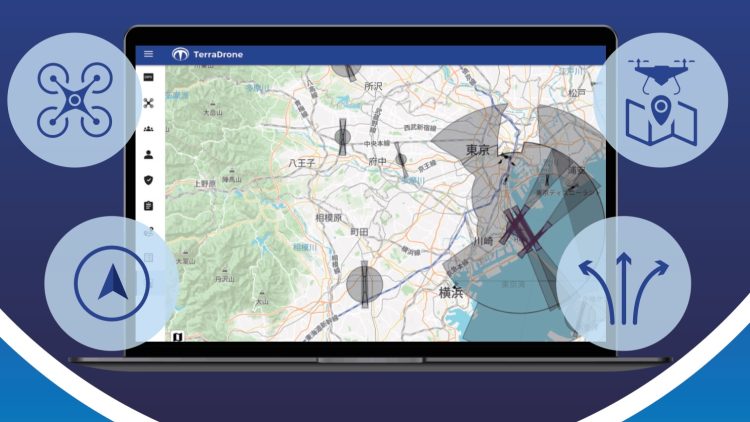
UTM (unmanned aircraft systems traffic management) enables safe airspace management for autonomous drone operations, multi-aircraft flights and beyond-visual-line-of-sight missions. Photo courtesy of Terra Drone (same below)
Demand is rising particularly fast in Japan’s rural areas, remote islands and mountainous regions, where populations are shrinking.
“Imagine an elderly person about to give up their driver’s license — instead of taking the wheel themselves to avoid danger, they could have what they need delivered by drone,” Ryu said. “That kind of scene may well become commonplace in the near future.”
Drone-based delivery of medicines, transport of daily necessities to mountain communities and remote infrastructure inspection are all areas where drones may offer more value outside cities than within them. UTM does not solve those problems directly, Ryu noted. But by creating an environment where drones can be used safely, it underpins efforts to address them.
The field also faces a clear dilemma: social need is high, but the road to profitability is long. As long as the number of drones in the air remains small, the need for traffic management is limited.
“You don’t need a management system in airspace where only one aircraft is flying,” Ryu said. “But when 10 or 100 aircraft are in the air, the value rises sharply.”
UTM, in other words, is infrastructure whose value grows as drone use spreads, rather than appearing at launch. For that reason, Terra Drone is focused less on near-term profit than on building the market itself — by cooperating with government authorities, contributing to regulatory design, and accumulating know-how through overseas deployments.
Its Belgium-based subsidiary Unifly, which operates mainly in Europe, plays a particularly important role. Unifly already has experience deploying and operating UTM systems in multiple countries, and that expertise is being applied to implementation in Japan.
“We aren’t at the stage of maximizing profits right now,” Ryu said. “We see this as a phase for pushing social implementation forward.”
Whether UTM becomes an indispensable piece of social infrastructure hinges on how widely and how often drones are used. Once they become part of daily life, airspace congestion is likely to emerge as a social problem — and demand for traffic management could surge.
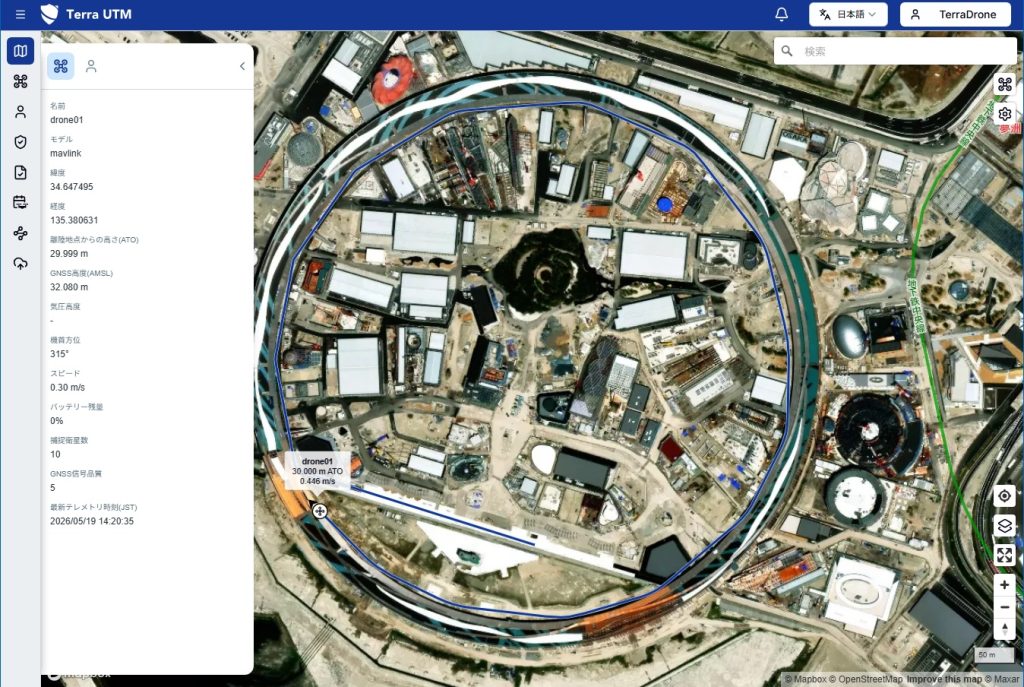
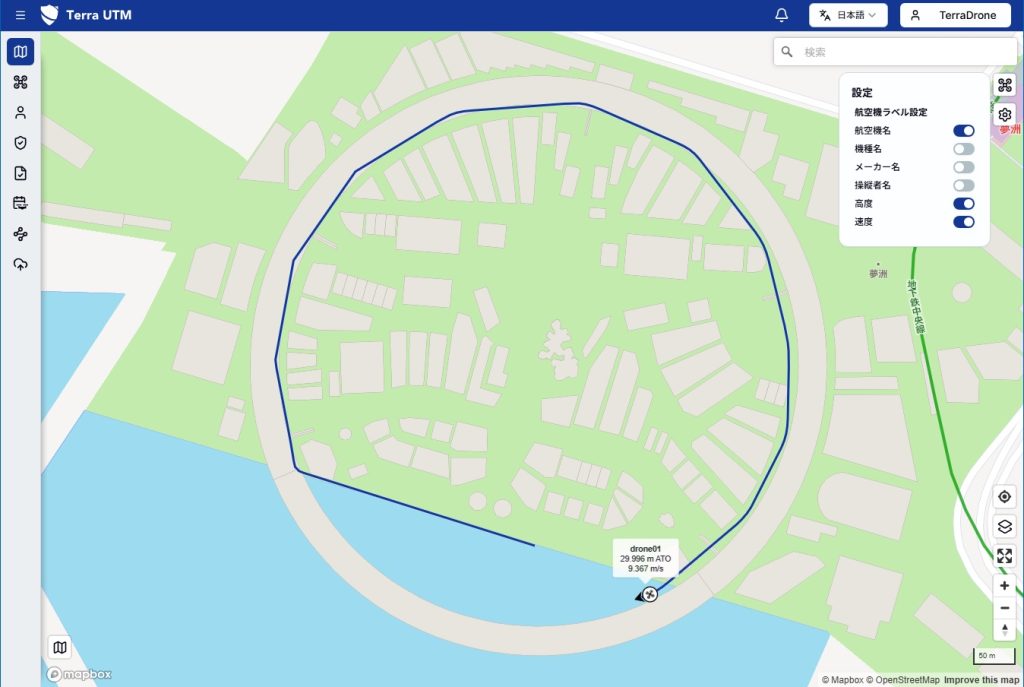
A UTMsystem interface showing real-time data such as drone altitude, speed, battery levels and flight routes.
The world is still finding its way
The infrastructure needed to support that future remains underdeveloped. A central question is who should pay to maintain and operate UTM: drone operators, the state as a provider of public infrastructure, or end users themselves. The world is still searching for an answer.
One thing seems clear, Ryu said: Once society recognizes the need, infrastructure can scale rapidly — much as the internet and GPS did.
Terra Drone envisions a future in which goods, not people, do more of the moving. Necessary items would arrive from the sky on demand; dangerous work would be unmanned; and the sky itself would be shared by many forms of mobility.
“Eventually, I think we’ll see an era when not only drones but flying cars share the same airspace,” Ryu said.
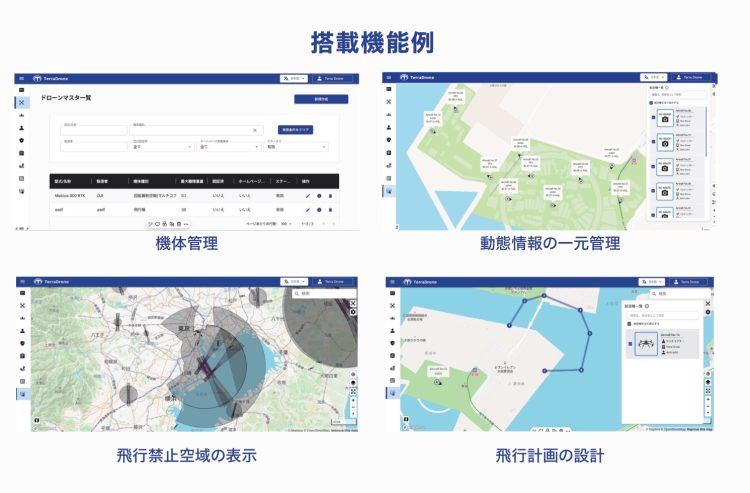
Examples of key functions of a UTM (unmanned aircraft systems traffic management) system.
From 2024 to 2033, the global drone market is forecast to grow at an average annual rate of 33%, reaching about $240 billion. The UTM market is projected to expand at an average annual rate of 22% over the same period, to roughly $6.08 billion.* As the drone market grows, the importance of UTM is expected to grow with it.
*Source: Arthur D. Little Japan, Inc., “UTM (Drone Traffic Management System) Global Market Research Project Deliverables (Final Report)” (2024). The report was prepared at the request of SMBC Nikko Securities Inc.
Translated by Mark Goldsmith
Edited by Mark Goldsmith
Top photo: Terra Drone Corp.
For inquiries regarding this article, please contact [email protected]