


• Login
Upgrade
JStories
  • 日本語
  • 中文 (中国)
No Result
View All Result
  • Home
  • AI
    • Artificial Intelligence
    • Robotics
    • Mobility
    • FinTech
    • Quantum
  • Earth
    • AgriTech
    • Green Innovation
    • Disaster Tech
    • SpaceTech
    • Materials
  • Life Sciences
    • BioTech
    • HealthTech
    • MedTech
    • AgeTech
  • Society
    • Media
    • EdTech
    • Diversity
    • FemTech
    • Social Impact
  • Lifestyle
    • FoodTech
    • Beauty & Fashion
    • Wellbeing
    • Arts & Music
    • Anime
  • Travel
    • Adventure Travel
    • Luxury Travel
    • Wellness & Medical Tourism
    • Culture
  • Video
  • Deals
    • Venture Capital
    • M&A
    • Events
    • Pitch
    • Growth Support
    • Legal & IP
  • Interview
  • Opinion
  • Home
  • AI
    • Artificial Intelligence
    • Robotics
    • Mobility
    • FinTech
    • Quantum
  • Earth
    • AgriTech
    • Green Innovation
    • Disaster Tech
    • SpaceTech
    • Materials
  • Life Sciences
    • BioTech
    • HealthTech
    • MedTech
    • AgeTech
  • Society
    • Media
    • EdTech
    • Diversity
    • FemTech
    • Social Impact
  • Lifestyle
    • FoodTech
    • Beauty & Fashion
    • Wellbeing
    • Arts & Music
    • Anime
  • Travel
    • Adventure Travel
    • Luxury Travel
    • Wellness & Medical Tourism
    • Culture
  • Video
  • Deals
    • Venture Capital
    • M&A
    • Events
    • Pitch
    • Growth Support
    • Legal & IP
  • Interview
  • Opinion
en English ja 日本語 zh 中文 (中国)
JStories
No Result
View All Result

Electric chopsticks help people eat less salt

Yui Sawada by Yui Sawada
06/01/2022
in AI, FoodTech, HealthTech, Life Sciences, Lifestyle, MedTech, News, Robotics, Wellbeing
0
Home AI
Share on FacebookShare on Twitter

J-STORIES – Japanese cuisine is famously healthy, but its Achilles’ heel is high salt content, leading to health problems such as high blood pressure. Many people must avoid salty foods or buy reduced-salt products that sometimes compromise on taste.

But what if there was a way to trick the taste buds into thinking food is saltier than it is? That’s the aim of a research project conducted by Meiji University and Kirin Holdings, both based in Tokyo.
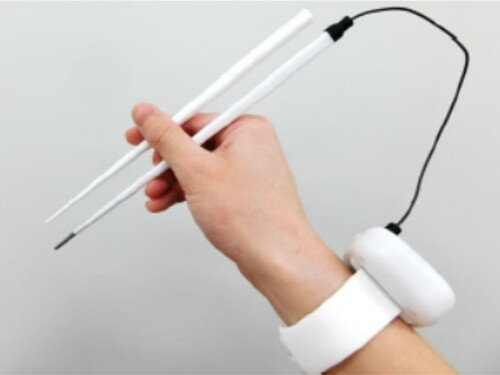
A pair of electric chopsticks.      Source: Kirin Holdings

This April, sales began of the researchers’ “electric chopsticks,” a digital update to the ancient eating utensil. The chopsticks deliver a small electric charge that strengthens tastes such as saltiness or umami. The electric shock is too small to be noticed but adjusts the movement of taste-producing sodium and other ions in the foods.

In clinical trials with people on low-salt diets, the device could increase perceived saltiness one and a half times. This was a world first

Professor Homei Miyashita, who has researched so-called “electric taste” for over 10 years, told J-Stories that they have a good understanding of the scientific principles behind producing taste.

Professor Homei Miyashita says that some people were nervous about putting electric chopsticks in their mouth, but became more enthusiastic after using them.      Source: Meiji University

“If we combine that knowledge with reduced-salt foods and aim for a synergistic effect between reduced-salt foods and our electric taste device,” he said, “we can increase the perception of taste more than one and a half times.”

In that way, it could be possible to more than halve the amount of salt in food, he said.

Kirin Holdings said, “We would first like to make practical use of the technology within Japan as one way to prevent the occurrence or worsening of lifestyle diseases.”

The researchers aim to commercialize the chopsticks device for general consumers by around 2023 to 2024. They have already made an electric Chinese-style spoon and bowl. And they also plan to make electric versions of Western cutlery, such as forks and spoons.

Translation and Editing by Tony McNicol

Top page photo by gstockstudio/ Envato

For inquires about this article, please contact us at jstories@pacificbridge.jp


Click here for the Japanese version of the article.

Tags: FoodHealth
Previous Post

Transporting liquefied hydrogen from Australia to Japan

Next Post

The Brief #14 Liquid hydrogen, Fish farm out of water, Taste-altering chopsticks

Yui Sawada

Yui Sawada

Related Posts

As the World Cup heats up, Japan’s cooling-wear industry sees its moment
Beauty & Fashion

As the World Cup heats up, Japan’s cooling-wear industry sees its moment

by JStories Editorial Team
06/18/2026
Japan’s Shionogi puts a last-resort antibiotic in the hands of doctors in 27 countries
MedTech

Japan’s Shionogi puts a last-resort antibiotic in the hands of doctors in 27 countries

by Toshi Maeda
06/15/2026
Japanese telecom bets on liquid cooling to take the heat out of AI’s energy crisis
Artificial Intelligence

Japanese telecom bets on liquid cooling to take the heat out of AI’s energy crisis

by Toshi Maeda
06/12/2026
測量、農業、インフラ点検から防衛まで、ドローンで社会課題を解決
Mobility

From surveying and agriculture to daily life and defense: Drones tackle society’s toughest challenges

by Hiroko Ishi
06/08/2026
Japan’s bendable solar film reaches data centers as AI strains the grid
Green Innovation

Japan’s bendable solar film reaches data centers as AI strains the grid

by Toshi Maeda
06/08/2026
Next Post

The Brief #14 Liquid hydrogen, Fish farm out of water, Taste-altering chopsticks

Leave a Reply Cancel reply

Your email address will not be published. Required fields are marked *

Trending

Greening the desert with trash

by Yui Sawada
03/23/2023
0

KYOTO (JStories) - The sight of local Niger women throwing kitchen waste out into the African desert inspired a project...

The world’s first drug that helps patients ‘grow new teeth’

by Ruiko Kokubun
09/22/2023
0

KYOTO (JStories) - The conventional way to help people who have lost teeth due to tooth decay or aging has...

Evolutionary artificial protein slated for market debut as early as June 2026

by Yoshiko Ohira
04/17/2026
0

JStories — Severe and hard-to-heal wounds — such as those caused by burns, injuries, pressure ulcers, skin cancer surgery, and...

Antibodies that grow teeth in wild-type mice. Source: Toregem Biopharma

World’s first ‘teething drug’ clinical trial starts in September – Aiming for full commercialization by 2030

by Ruriko Kokubun
06/07/2024
0

Editor's Note: This article has been updated with new information. It was originally published on 09/22/2023. J-STORIES - The conventional...

JStories

©Articles and photos published on JStories are protected by Japanese copyright law and international treaties. They cannot be reproduced without the permission of the copyright holders

Explore JStories

  • Home
  • About JStories
  • JStories Newsletter Sign-Up
  • Company
  • Team
  • Contact
  • Privacy Policy
  • Partner Press Releases

Follow Us

Welcome Back!

Login to your account below

Forgotten Password?

Retrieve your password

Please enter your username or email address to reset your password.

Log In
No Result
View All Result
  • TOP STORIES
  • AI
    • Artificial Intelligence
    • Robotics
    • Mobility
    • FinTech
    • Quantum
  • Earth
    • AgriTech
    • Green Innovation
    • Disaster Tech
    • SpaceTech
    • Materials
  • Life Sciences
    • BioTech
    • HealthTech
    • MedTech
    • AgeTech
  • Society
    • Media
    • EdTech
    • Diversity
    • FemTech
    • Social Impact
  • Lifestyle
    • FoodTech
    • Beauty & Fashion
    • Wellbeing
    • Arts & Music
    • Anime
  • Travel
    • Adventure Travel
    • Luxury Travel
    • Wellness & Medical Tourism
    • Culture
  • Video
  • Deals
    • Venture Capital
    • M&A
    • Events
    • Growth Support
    • Legal & IP
  • Interview
  • Opinion

©Articles and photos published on JStories are protected by Japanese copyright law and international treaties. They cannot be reproduced without the permission of the copyright holders

Not enough quota to unlock this post
Unlock left : 0
Are you sure want to cancel subscription?