



• Login
Upgrade
JStories
  • 日本語
  • 中文 (中国)
No Result
View All Result
  • Home
  • AI
    • Artificial Intelligence
    • Robotics
    • Mobility
    • FinTech
    • Quantum
  • Earth
    • AgriTech
    • Green Innovation
    • Disaster Tech
    • SpaceTech
    • Materials
  • Life Sciences
    • BioTech
    • HealthTech
    • MedTech
    • AgeTech
  • Society
    • Media
    • EdTech
    • Diversity
    • FemTech
    • Social Impact
  • Lifestyle
    • FoodTech
    • Beauty & Fashion
    • Wellbeing
    • Arts & Music
    • Anime
  • Travel
    • Adventure Travel
    • Luxury Travel
    • Wellness & Medical Tourism
    • Culture
  • Video
  • Deals
    • Venture Capital
    • M&A
    • Events
    • Pitch
    • Growth Support
    • Legal & IP
  • Interview
  • Opinion
  • Home
  • AI
    • Artificial Intelligence
    • Robotics
    • Mobility
    • FinTech
    • Quantum
  • Earth
    • AgriTech
    • Green Innovation
    • Disaster Tech
    • SpaceTech
    • Materials
  • Life Sciences
    • BioTech
    • HealthTech
    • MedTech
    • AgeTech
  • Society
    • Media
    • EdTech
    • Diversity
    • FemTech
    • Social Impact
  • Lifestyle
    • FoodTech
    • Beauty & Fashion
    • Wellbeing
    • Arts & Music
    • Anime
  • Travel
    • Adventure Travel
    • Luxury Travel
    • Wellness & Medical Tourism
    • Culture
  • Video
  • Deals
    • Venture Capital
    • M&A
    • Events
    • Pitch
    • Growth Support
    • Legal & IP
  • Interview
  • Opinion
en English ja 日本語 zh 中文 (中国)
JStories
No Result
View All Result

No space for debris

Ayaka Sagasaki by Ayaka Sagasaki
11/09/2022
in Earth, Green Innovation, News, SpaceTech
0
Home Earth
Share on FacebookShare on Twitter

J-STORIES – The increasing volume of debris floating around in space is a potential hindrance to future space development. But a Japanese company has developed a cleanup technology to reduce such space junk.

The Tokyo-based Astroscale Holdings is the world’s first private company specializing in space debris removal. Founded in 2013, it is aggressively developing its business with domestic and foreign partners, including Japan Aerospace Exploration Agency (JAXA) and the UK Space Agency, with the aim of commercializing its services by 2030.

Identifying the problem is relatively simple. In space, a vast amount of space debris, such as satellites, rockets, and their parts and fragments, is never recovered or removed and is left drifting in space. This causes debris to collide not only with each other but with new satellites as well.

According to JAXA, the amount of space debris in orbit currently stands at about 20,000 pieces larger than 10 centimeters and 100 million pieces larger than 1 millimeters. In low orbit, debris orbits the earth at a speed of around 8 kilometers per second, and if it collides with a manned satellite or the International Space Station (ISS), it could endanger lives.

An artist’s impression of space debris surrounding Earth. There are an estimated 100,000 pieces larger than 1mm, and the amount is constantly increasing.     Source: FrameStock/Envato

As a countermeasure, JAXA is engaged in the world’s first large debris recovery program targeting the upper stages of rockets and discarded satellites. Called the Commercial Removal of Debris Demonstration, the program aims to demonstrate technologies for removing large debris and to pave the way for private companies such as Astroscale to conduct debris removal as a business.

Astroscale is a partner company in Phase 1 of the program, which aims to demonstrate technologies for approaching debris, and in August of this year, the company was selected as one of the partners for Phase 2, which aims to capture and remove debris.
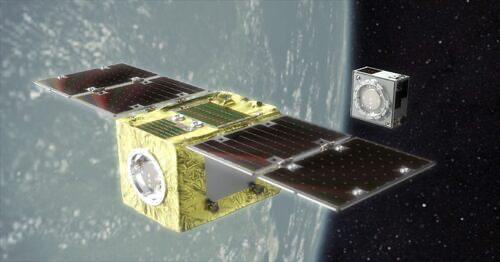
An artist’s impression of ELSA-d, Astroscale’s space debris removal demonstration satellite. Simulated debris is shown on the right.     Source: Astroscale

In this program, Astroscale is responsible for the design, manufacturing, and operation of the demonstration satellite ADRAS-J, which is scheduled to be launched within this fiscal year. Astroscale has successfully guided the debris removal demonstration satellite “ELSA-d” through a simulated debris environment as part of its own project, and is utilizing this technology and knowledge in the JAXA program as well.

Based on the results of the ELSA-d test, the company is developing ELSA-M, which can capture and remove multiple pieces of debris in a single mission. It is being undertaken in partnership with OneWeb, a U.S. satellite communications company, and plans are in the pipeline to conduct an in-orbit demonstration test by the end of 2024.
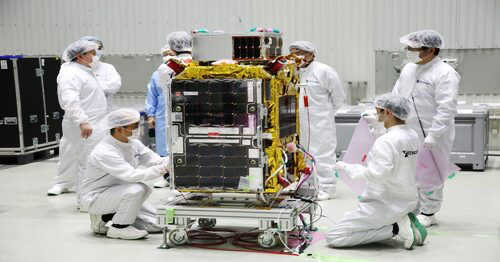
Technicians test out the ELSA-d satellite before its launch in 2021.     Source: Astroscale

Astroscale is also expanding its collaboration with the UK Space Agency, which is active in debris removal and plans to remove two British satellites by 2026. This September the company’s British subsidiary was awarded an additional £1.7 million in development funding from the UK Space Agency. The organization has built a satellite manufacturing and operations facility in Oxfordshire, England, which has recently begun operations.

Miki Ito, president of the company’s Japanese subsidiary, told J-Stories that the company’s on-orbit services can contribute to debris removal and the realization of space sustainability. “We hope to develop and demonstrate on-orbit services as a daily infrastructure service by 2030,” he said.

Translation by Tony McNicol

Top page photo by goinyk/Envato

For inquiries about this article, please contact us at jstories@pacificbridge.jp


.

Tags: InfrastructureSpaceSustainable SocietyTechnology
Previous Post

Connecting the Dots for African communities

Next Post

Old rags to vaccine riches

Ayaka Sagasaki

Ayaka Sagasaki

Related Posts

One typhoon, four warning systems: Japanese AI stitches the disaster picture together
Disaster Tech

One typhoon, four warning systems: Japanese AI stitches the disaster picture together

by JStories Editorial Team
07/15/2026
As Venezuela’s quake cuts off water, a Japanese recycler shows another way
Disaster Tech

As Venezuela’s quake cuts off water, a Japanese recycler shows another way

by JStories Editorial Team
07/10/2026
日本の温泉郷に眠る地熱発電、AIデータセンターの電力源として新たな期待
Earth

Geothermal Power Taps a ‘Buried Treasure’ to Revitalize a Hot Spring Region

by Yoshiko Ohira
07/08/2026
As deepfake scams spread, a Japanese institute builds detectors to catch them
Artificial Intelligence

As deepfake scams spread, a Japanese institute builds detectors to catch them

by JStories Editorial Team
07/03/2026
Sony’s neck-worn cooler targets a world running short on ways to beat the heat
Green Innovation

Sony’s neck-worn cooler targets a world running short on ways to beat the heat

by JStories Editorial Team
07/01/2026
Next Post

Old rags to vaccine riches

Leave a Reply Cancel reply

Your email address will not be published. Required fields are marked *

Trending

Greening the desert with trash

by Yui Sawada
03/23/2023
0

KYOTO (JStories) - The sight of local Niger women throwing kitchen waste out into the African desert inspired a project...

Evolutionary artificial protein slated for market debut as early as June 2026

by Yoshiko Ohira
04/17/2026
0

JStories — Severe and hard-to-heal wounds — such as those caused by burns, injuries, pressure ulcers, skin cancer surgery, and...

Ai Heart Japan

Ai Heart Japan

by Jstories
06/18/2024
0

https://www.youtube.com/watch?v=q0fmsRv3ZjQ Company Profile Startup Name: Ai Heart Japan Co., Ltd. Stage: Early-stage (founded March 30, 2021) Location: Japan Website: https://ai-heart.jp/...

AssistMotion Inc.

AssistMotion Inc.

by Jstories
06/18/2024
0

https://www.youtube.com/watch?v=xQrw2hrDzzc Pitch by the representative director of AssistMotion Minoru Hashimoto Company Profile Startup Name: AssistMotion Inc. Stage: Early-stage / Seed...

A pocket-size AED innovation to save more lives

by Suvendrini Kakuchi
09/11/2025
0

JStories ー A Japanese startup has developed a pocket-size automated external defibrillator (AED) — about the size and weight of...

JStories

©Articles and photos published on JStories are protected by Japanese copyright law and international treaties. They cannot be reproduced without the permission of the copyright holders

Explore JStories

  • Home
  • About JStories
  • JStories Newsletter Sign-Up
  • Company
  • Team
  • Contact
  • Privacy Policy
  • Partner Press Releases

Follow Us

Welcome Back!

Login to your account below

Forgotten Password?

Retrieve your password

Please enter your username or email address to reset your password.

Log In
No Result
View All Result
  • TOP STORIES
  • AI
    • Artificial Intelligence
    • Robotics
    • Mobility
    • FinTech
    • Quantum
  • Earth
    • AgriTech
    • Green Innovation
    • Disaster Tech
    • SpaceTech
    • Materials
  • Life Sciences
    • BioTech
    • HealthTech
    • MedTech
    • AgeTech
  • Society
    • Media
    • EdTech
    • Diversity
    • FemTech
    • Social Impact
  • Lifestyle
    • FoodTech
    • Beauty & Fashion
    • Wellbeing
    • Arts & Music
    • Anime
  • Travel
    • Adventure Travel
    • Luxury Travel
    • Wellness & Medical Tourism
    • Culture
  • Video
  • Deals
    • Venture Capital
    • M&A
    • Events
    • Growth Support
    • Legal & IP
  • Interview
  • Opinion

©Articles and photos published on JStories are protected by Japanese copyright law and international treaties. They cannot be reproduced without the permission of the copyright holders

Not enough quota to unlock this post
Unlock left : 0
Are you sure want to cancel subscription?