
• Login
Upgrade
JStories
  • 日本語
  • 中文 (中国)
No Result
View All Result
  • Home
  • AI
    • Artificial Intelligence
    • Robotics
    • Mobility
    • FinTech
    • Quantum
  • Earth
    • AgriTech
    • Green Innovation
    • Disaster Tech
    • SpaceTech
    • Materials
  • Life Sciences
    • BioTech
    • HealthTech
    • MedTech
    • AgeTech
  • Society
    • Media
    • EdTech
    • Diversity
    • FemTech
    • Social Impact
  • Lifestyle
    • FoodTech
    • Beauty & Fashion
    • Wellbeing
    • Arts & Music
    • Anime
  • Travel
    • Adventure Travel
    • Luxury Travel
    • Wellness & Medical Tourism
    • Culture
  • Video
  • Deals
    • Venture Capital
    • M&A
    • Events
    • Pitch
    • Growth Support
    • Legal & IP
  • Interview
  • Opinion
  • Home
  • AI
    • Artificial Intelligence
    • Robotics
    • Mobility
    • FinTech
    • Quantum
  • Earth
    • AgriTech
    • Green Innovation
    • Disaster Tech
    • SpaceTech
    • Materials
  • Life Sciences
    • BioTech
    • HealthTech
    • MedTech
    • AgeTech
  • Society
    • Media
    • EdTech
    • Diversity
    • FemTech
    • Social Impact
  • Lifestyle
    • FoodTech
    • Beauty & Fashion
    • Wellbeing
    • Arts & Music
    • Anime
  • Travel
    • Adventure Travel
    • Luxury Travel
    • Wellness & Medical Tourism
    • Culture
  • Video
  • Deals
    • Venture Capital
    • M&A
    • Events
    • Pitch
    • Growth Support
    • Legal & IP
  • Interview
  • Opinion
en English ja 日本語 zh 中文 (中国)
JStories
No Result
View All Result

From lethal poison to life-saving panacea

Ayaka Sagasaki by Ayaka Sagasaki
02/01/2023
in HealthTech, Life Sciences, MedTech, News
0
Home Life Sciences HealthTech
Share on FacebookShare on Twitter

J-STORIES – A Japanese company has come up with a groundbreaking drug development program that looks set to turn deadly poisons into life-saving medicinal applications for humans, animals and even plants.

The Veneno Suite developed by Ibaraki-headquartered Veneno Technologies provides an innovative way to overcome difficulties in producing drugs from venom found in creatures such as snakes, scorpions and spiders by genetically altering elements of those venoms.

Animal venoms contain peptides (amino acid compounds known for their capacity to treat diseases and kill microbes), many of which affect specific physiological functions in humans. One kind in particular, disulfide-rich peptides (DRPs), are found throughout nature and are known to possess enormous potential as a tool for developing new drugs.

There have been attempts to make drugs using DRPs in the past, but few have succeeded due to the complexity of the peptides and the difficulty of the task.

This was a key motivator for Veneno Technologies when it was founded In 2020 by Tadashi Kimura, an expert in tarantula venom at the National Institute of Advanced Industrial Science and Technology, and Kazunori Yoshikawa, who has worked on developing new drugs for a major pharmaceutical company and several startups. The company’s groundbreaking Veneno Suite drug development platform was launched in the belief it could help solve the complications that have hampered development to date.

One of the Veneno Suite’s core technologies is the “DRP space” method of collating genetic libraries. While the creation of genetic libraries of the peptides found in natural venom is time-consuming and complicated using conventional methods, Veneno has developed a way to use a single DRP as a model and genetically alter parts to quickly create a huge and varied stock of DRPs.
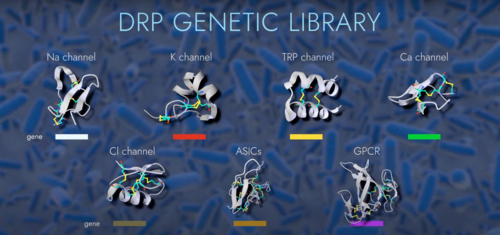
There are 1 billion peptides in the company’s DRP library.     Source: Veneno Technologies

Veneno has also developed its own innovative technology to sort through this massive library of peptides. Named PERISS, it uses E. coli colon bacteria to select the best peptide for developing a particular drug. The bacteria simultaneously expresses DRPs and ion channels to efficiently screen DRPs, and is the only technology of its kind in the world, says Yoshikawa, who is the company’s CEO.

What differentiates this method from other screening method is that DRPs and target molecules such as ion channels can be simultaneously expressed on the inner membrane of E. coli for efficient screening, making it “the only technology of its kind in the world,” Yoshikawa says.

DRPs and target molecules such as ion channels can be simultaneously expressed on the inner membrane of E. coli for efficient screening.     Source: Veneno Technologies

Veneno is already using the platform for joint research work with pharmaceutical companies to develop DRPs that can be used for medicines. Currently with operations in both Japan and the United States, Veneno is looking toward global expansion. At the same time, it is conducting its own in-house research with the intention of licensing DRPs with drug development potential to pharmaceutical companies. “We absolutely have to use DRPs to make medicines,” Yoshikawa says.

DRPs also affect animals, insects, plants, and bacteria, so they can also be used to make new veterinary drugs and agricultural chemicals. In particular, the company is talking with chemical manufacturers about the development of agricultural chemicals that are more friendly to the environment.

Translation by Tony McNicol

Top page photo by Rawpixel/Envato

For inquiries about this article, please contact jstories@pacificbridge.jp


.

Tags: HealthMedicineSocietyTechnology
Previous Post

The Brief #42 Automated drive vision, Underwater WiFi

Next Post

The Brief #43 Poison to medicine, Fuji five lakes

Ayaka Sagasaki

Ayaka Sagasaki

Related Posts

One typhoon, four warning systems: Japanese AI stitches the disaster picture together
Disaster Tech

One typhoon, four warning systems: Japanese AI stitches the disaster picture together

by JStories Editorial Team
07/15/2026
As Venezuela’s quake cuts off water, a Japanese recycler shows another way
Disaster Tech

As Venezuela’s quake cuts off water, a Japanese recycler shows another way

by JStories Editorial Team
07/10/2026
日本の温泉郷に眠る地熱発電、AIデータセンターの電力源として新たな期待
Earth

Geothermal Power Taps a ‘Buried Treasure’ to Revitalize a Hot Spring Region

by Yoshiko Ohira
07/08/2026
As deepfake scams spread, a Japanese institute builds detectors to catch them
Artificial Intelligence

As deepfake scams spread, a Japanese institute builds detectors to catch them

by JStories Editorial Team
07/03/2026
Sony’s neck-worn cooler targets a world running short on ways to beat the heat
Green Innovation

Sony’s neck-worn cooler targets a world running short on ways to beat the heat

by JStories Editorial Team
07/01/2026
Next Post

The Brief #43 Poison to medicine, Fuji five lakes

Leave a Reply Cancel reply

Your email address will not be published. Required fields are marked *

Trending

Greening the desert with trash

by Yui Sawada
03/23/2023
0

KYOTO (JStories) - The sight of local Niger women throwing kitchen waste out into the African desert inspired a project...

Evolutionary artificial protein slated for market debut as early as June 2026

by Yoshiko Ohira
04/17/2026
0

JStories — Severe and hard-to-heal wounds — such as those caused by burns, injuries, pressure ulcers, skin cancer surgery, and...

Ai Heart Japan

Ai Heart Japan

by Jstories
06/18/2024
0

https://www.youtube.com/watch?v=q0fmsRv3ZjQ Company Profile Startup Name: Ai Heart Japan Co., Ltd. Stage: Early-stage (founded March 30, 2021) Location: Japan Website: https://ai-heart.jp/...

AssistMotion Inc.

AssistMotion Inc.

by Jstories
06/18/2024
0

https://www.youtube.com/watch?v=xQrw2hrDzzc Pitch by the representative director of AssistMotion Minoru Hashimoto Company Profile Startup Name: AssistMotion Inc. Stage: Early-stage / Seed...

Antibodies that grow teeth in wild-type mice. Source: Toregem Biopharma

World’s first ‘teething drug’ clinical trial starts in September – Aiming for full commercialization by 2030

by Ruriko Kokubun
06/07/2024
0

Editor's Note: This article has been updated with new information. It was originally published on 09/22/2023. J-STORIES - The conventional...

JStories

©Articles and photos published on JStories are protected by Japanese copyright law and international treaties. They cannot be reproduced without the permission of the copyright holders

Explore JStories

  • Home
  • About JStories
  • JStories Newsletter Sign-Up
  • Company
  • Team
  • Contact
  • Privacy Policy
  • Partner Press Releases

Follow Us

Welcome Back!

Login to your account below

Forgotten Password?

Retrieve your password

Please enter your username or email address to reset your password.

Log In
No Result
View All Result
  • TOP STORIES
  • AI
    • Artificial Intelligence
    • Robotics
    • Mobility
    • FinTech
    • Quantum
  • Earth
    • AgriTech
    • Green Innovation
    • Disaster Tech
    • SpaceTech
    • Materials
  • Life Sciences
    • BioTech
    • HealthTech
    • MedTech
    • AgeTech
  • Society
    • Media
    • EdTech
    • Diversity
    • FemTech
    • Social Impact
  • Lifestyle
    • FoodTech
    • Beauty & Fashion
    • Wellbeing
    • Arts & Music
    • Anime
  • Travel
    • Adventure Travel
    • Luxury Travel
    • Wellness & Medical Tourism
    • Culture
  • Video
  • Deals
    • Venture Capital
    • M&A
    • Events
    • Growth Support
    • Legal & IP
  • Interview
  • Opinion

©Articles and photos published on JStories are protected by Japanese copyright law and international treaties. They cannot be reproduced without the permission of the copyright holders

Not enough quota to unlock this post
Unlock left : 0
Are you sure want to cancel subscription?