
• Login
Upgrade
JStories
  • 日本語
  • 中文 (中国)
No Result
View All Result
  • Home
  • AI
    • Artificial Intelligence
    • Robotics
    • Mobility
    • FinTech
    • Quantum
  • Earth
    • AgriTech
    • Green Innovation
    • Disaster Tech
    • SpaceTech
    • Materials
  • Life Sciences
    • BioTech
    • HealthTech
    • MedTech
    • AgeTech
  • Society
    • Media
    • EdTech
    • Diversity
    • FemTech
    • Social Impact
  • Lifestyle
    • FoodTech
    • Beauty & Fashion
    • Wellbeing
    • Arts & Music
    • Anime
  • Travel
    • Adventure Travel
    • Luxury Travel
    • Wellness & Medical Tourism
    • Culture
  • Video
  • Deals
    • Venture Capital
    • M&A
    • Events
    • Pitch
    • Growth Support
    • Legal & IP
  • Interview
  • Opinion
  • Home
  • AI
    • Artificial Intelligence
    • Robotics
    • Mobility
    • FinTech
    • Quantum
  • Earth
    • AgriTech
    • Green Innovation
    • Disaster Tech
    • SpaceTech
    • Materials
  • Life Sciences
    • BioTech
    • HealthTech
    • MedTech
    • AgeTech
  • Society
    • Media
    • EdTech
    • Diversity
    • FemTech
    • Social Impact
  • Lifestyle
    • FoodTech
    • Beauty & Fashion
    • Wellbeing
    • Arts & Music
    • Anime
  • Travel
    • Adventure Travel
    • Luxury Travel
    • Wellness & Medical Tourism
    • Culture
  • Video
  • Deals
    • Venture Capital
    • M&A
    • Events
    • Pitch
    • Growth Support
    • Legal & IP
  • Interview
  • Opinion
en English ja 日本語 zh 中文 (中国)
JStories
No Result
View All Result

One typhoon, four warning systems: Japanese AI stitches the disaster picture together

While Typhoon Bavi's 72-hour rampage was well forecast, it was poorly seen, as no single agency could track who was flooded, stranded or in the dark as it moved.

JStories Editorial Team by JStories Editorial Team
07/15/2026
in Disaster Tech, AI, Artificial Intelligence, Earth, News
0
Home Earth Disaster Tech
Share on FacebookShare on Twitter

PROBLEM: Typhoon Bavi swept from the Philippines to China in 72 hours, killing 18 in the Philippines, cutting power across Japan’s southwest and Taiwan, and forcing nearly two million Chinese to evacuate.

POTENTIAL SOLUTION: Used by more than 1,000 organizations in Japan and by Philippine government agencies, Spectee Pro is a Tokyo-built AI service that fuses social posts, cameras, weather and vehicle data to map disasters within minutes.


Currently situated over eastern China, Typhoon Bavi made landfall in China’s eastern Zhejiang province late Saturday with winds of 144 kph, after authorities evacuated nearly 2 million people from its path, about 1.7 million in Zhejiang alone, plus more than 100,000 from both Fujian province and Beijing. By Sunday it had weakened to a severe tropical storm, with no immediate reports of deaths or damage in China.

The rest of its 72-hour trail was heavier. The storm killed 18 people in the Philippines, knocked out power to thousands of households across Japan’s remote southwestern islands, and cut electricity to more than 170,000 households in Taiwan.

A storm like Bavi outruns information as it moves: one weekend, four separate warning systems, four languages, no shared picture.

Assembling that fragmented picture in real time is a service provided by Spectee, a Tokyo company founded in 2011. Its main service, Spectee Pro, uses AI to analyze social media posts, weather data, satellite imagery, river and road cameras, and location data from vehicles, then verifies and maps incidents within minutes.

Teaching machines to watch the whole storm
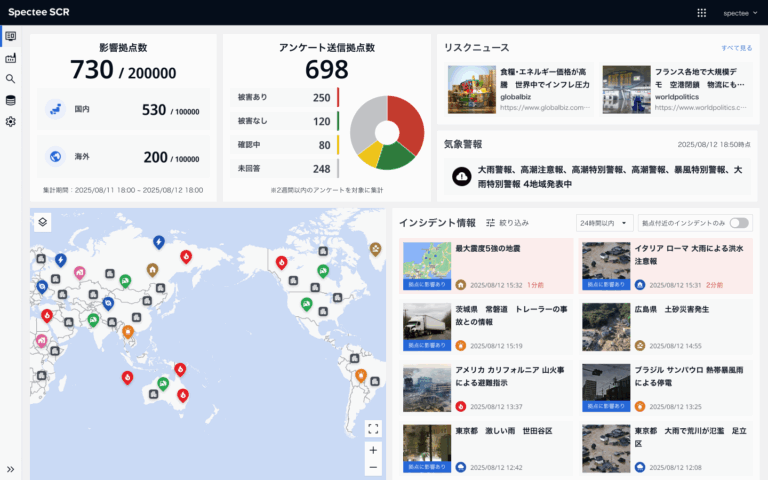
Picture of Spectee SCR service

In two of the places in Bavi’s path, Spectee’s infrastructure is already established. In Japan, contracts passed 1,000 in July 2024, spanning municipal governments, broadcasters, infrastructure operators, manufacturers and logistics firms, many of which rely on it for the first report when disaster strikes.

In the Philippines, more than 120 licenses are in use across central and local government agencies, and the company is expanding to Indonesia with backing from JICA, Japan’s development agency. Whether Spectee’s systems were used during Bavi’s passage specifically has not been confirmed for this article, but the storm ran directly through the company’s two main markets.

Investors closed a 1.6 billion yen (roughly 10 million dollar) funding round at the end of March, and the company shipped its latest update, adding road and river cameras to its supply-chain risk product, on July 8. These developments have shown promising growth in the business itself and alongside their products possibly alluding to more expansions to come in the coming years.

The Tottori anti-misinformation partnership

In May, Spectee announced that the company is partnering with Tottori Prefecture to develop new functionality against rumors and fake information spread on social media during disasters; when a high-impact disaster occurs, widely-circulating posts judged to be of questionable reliability will be flagged with reasons and cautionary notes inside Spectee Pro, for municipalities to use in alerting residents.

The prefecture will pilot the feature from June to August, after which, it will be judged whether its performance for administrative decisions are useful enough to be released. The collaboration draws on Tottori’s fake-information response team founded in November 2024, and was prompted in part by a January earthquake after which a video falsely showing large cracks in the Tottori sand dunes spread online.
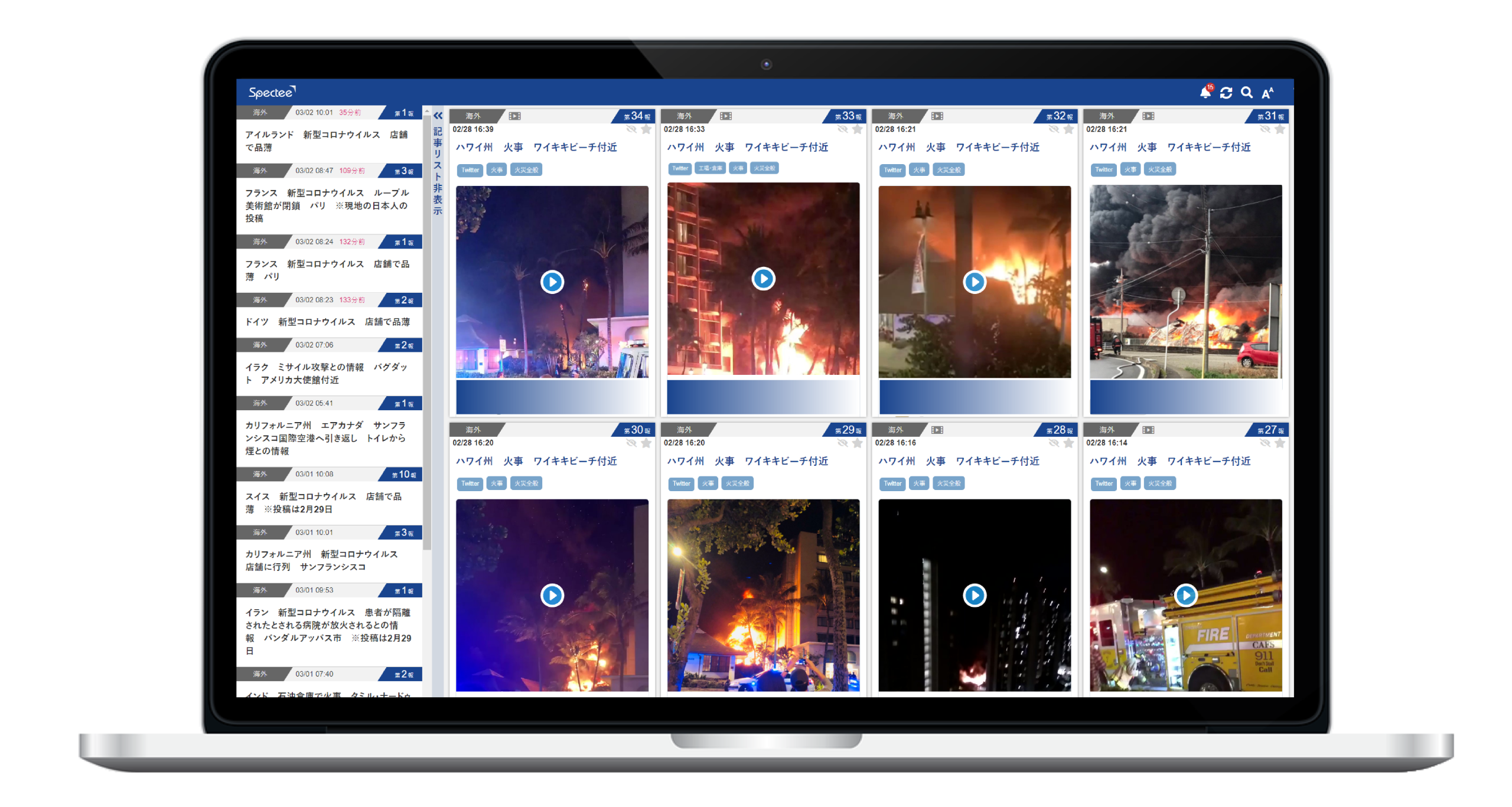
Image of how Spectee Pro works on the laptop. Source: Spectee Inc. YouTube channel

What the record shows and what it doesn’t

The strongest evidence is that institutions keep paying. A Hokkaido city ran a full drill last December using social posts to visualize evacuations in real time. What’s missing is independent proof of outcomes: no third-party study yet shows the alerts measurably reducing casualties or damage. Adoption is not the same as lives saved.

A US firm known as Dataminr is currently Spectee’s biggest competitor. However, with cross-checked posts against cameras, vehicle data and satellites, combined with a decade of Japanese disaster data. It is safe to say that Spectee has had a long list of past cases to refer to which may potentially be what sets them aside other similar services.


Why it matters: Japan’s disaster-prone geography made it an early adopter of crisis technology, and that decade of refinement is now exported along the typhoon track. Bavi’s weekend is the argument in miniature: the meteorology was shared; the real-time picture of who was flooded, blacked out or stranded was not.

 

Previous Post

As Venezuela’s quake cuts off water, a Japanese recycler shows another way

JStories Editorial Team

JStories Editorial Team

The JStories Editorial Team is a group of experienced, multilingual and multicultural journalists based in Tokyo, many of whom have reported for major international news organizations such as Reuters. Drawing on decades of combined experience across television, wire, and print journalism, the team produces solutions-focused stories that meet global broadcast and editorial standards. The team is led by Toshi Maeda, a former producer and correspondent for Reuters TV. Earlier in his career, Maeda worked as a reporter at The Japan Times in Japan, The Associated Press in San Francisco, Newsday in New York, and The Desert Sun in Palm Springs, California. He has also taught journalism at Komazawa University's Faculty of Global Media Studies.

Related Posts

As Venezuela’s quake cuts off water, a Japanese recycler shows another way
Disaster Tech

As Venezuela’s quake cuts off water, a Japanese recycler shows another way

by JStories Editorial Team
07/10/2026
日本の温泉郷に眠る地熱発電、AIデータセンターの電力源として新たな期待
Earth

Geothermal Power Taps a ‘Buried Treasure’ to Revitalize a Hot Spring Region

by Yoshiko Ohira
07/08/2026
As deepfake scams spread, a Japanese institute builds detectors to catch them
Artificial Intelligence

As deepfake scams spread, a Japanese institute builds detectors to catch them

by JStories Editorial Team
07/03/2026
Sony’s neck-worn cooler targets a world running short on ways to beat the heat
Green Innovation

Sony’s neck-worn cooler targets a world running short on ways to beat the heat

by JStories Editorial Team
07/01/2026
As the World Cup heats up, Japan’s cooling-wear industry sees its moment
Beauty & Fashion

As the World Cup heats up, Japan’s cooling-wear industry sees its moment

by JStories Editorial Team
06/18/2026

Leave a Reply Cancel reply

Your email address will not be published. Required fields are marked *

Trending

Greening the desert with trash

by Yui Sawada
03/23/2023
0

KYOTO (JStories) - The sight of local Niger women throwing kitchen waste out into the African desert inspired a project...

The world’s first drug that helps patients ‘grow new teeth’

by Ruiko Kokubun
09/22/2023
0

KYOTO (JStories) - The conventional way to help people who have lost teeth due to tooth decay or aging has...

Evolutionary artificial protein slated for market debut as early as June 2026

by Yoshiko Ohira
04/17/2026
0

JStories — Severe and hard-to-heal wounds — such as those caused by burns, injuries, pressure ulcers, skin cancer surgery, and...

Ai Heart Japan

Ai Heart Japan

by Jstories
06/18/2024
0

https://www.youtube.com/watch?v=q0fmsRv3ZjQ Company Profile Startup Name: Ai Heart Japan Co., Ltd. Stage: Early-stage (founded March 30, 2021) Location: Japan Website: https://ai-heart.jp/...

JStories

©Articles and photos published on JStories are protected by Japanese copyright law and international treaties. They cannot be reproduced without the permission of the copyright holders

Explore JStories

  • Home
  • About JStories
  • JStories Newsletter Sign-Up
  • Company
  • Team
  • Contact
  • Privacy Policy
  • Partner Press Releases

Follow Us

Welcome Back!

Login to your account below

Forgotten Password?

Retrieve your password

Please enter your username or email address to reset your password.

Log In
No Result
View All Result
  • TOP STORIES
  • AI
    • Artificial Intelligence
    • Robotics
    • Mobility
    • FinTech
    • Quantum
  • Earth
    • AgriTech
    • Green Innovation
    • Disaster Tech
    • SpaceTech
    • Materials
  • Life Sciences
    • BioTech
    • HealthTech
    • MedTech
    • AgeTech
  • Society
    • Media
    • EdTech
    • Diversity
    • FemTech
    • Social Impact
  • Lifestyle
    • FoodTech
    • Beauty & Fashion
    • Wellbeing
    • Arts & Music
    • Anime
  • Travel
    • Adventure Travel
    • Luxury Travel
    • Wellness & Medical Tourism
    • Culture
  • Video
  • Deals
    • Venture Capital
    • M&A
    • Events
    • Growth Support
    • Legal & IP
  • Interview
  • Opinion

©Articles and photos published on JStories are protected by Japanese copyright law and international treaties. They cannot be reproduced without the permission of the copyright holders

Not enough quota to unlock this post
Unlock left : 0
Are you sure want to cancel subscription?