



TOKYO (JStories) — As global supply chains rewire and the world’s largest economies retrench behind tariffs and tech controls, two regions are quietly designing something different.
On August 24-26, the Inter-American Development Bank Group and Japan’s Ministry of Finance will convene roughly 300 senior public- and private-sector leaders at the Akasaka Intercity Conference Center for the Japan-LAC Business Forum, marking 50 years of Japan’s membership in the IDB — and positioning innovation, not great-power rivalry, as the organizing principle of a new chapter.
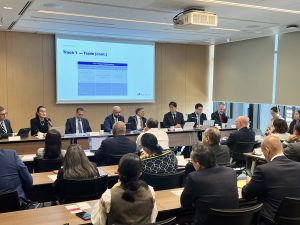
The pitch from the Washington-headquartered IDB, whose officials briefed Latin American ambassadors in Tokyo this week, is uniquely targeted at Japanese companies.

“This is a key moment so we can have Japan and Latin America and the Caribbean getting closer,” André Soares, chief of the Office of the Presidency at the IDB, told JStories.
He listed the sectors where matchmaking is expected to be densest: critical minerals, food and agriculture, infrastructure, technology, and the silver economy — where Japan’s experience with rapid aging can be exported to a region that, in Soares’s words, is growing older “faster” than expected and “not as rich as Japan.”
Organizers are candid that visibility is the main obstacle. A recent JBIC survey of Japanese manufacturers’ overseas business plans showed almost no Latin American country on the three-year radar of corporate Japan besides Brazil and Mexico. Latin American diplomats in Tokyo, at the IDB briefing this week, suggested the result underscored how much work remains to put the region on the map for Japanese boardrooms — and how valuable a Forum of this scale could be. The August event is the IDB’s most concentrated attempt yet to close that gap.
The case for Japanese companies is built on numbers that have shifted quickly. Japan is now the IDB’s largest international-cooperation donor: roughly $4 billion committed through the JICA CORE public-sector co-financing program to date. A newer private-sector structure, TADAC, which co-finances deals with IDB Invest, deployed nearly $1 billion in barely a year and is heading toward $1.5 billion. Japanese Trust Funds, in place since 1976, have channeled some $500 million in grants, increasingly toward critical minerals, agriculture, and water. TSUBASA, an IDB Lab program built with JICA to bring Japanese startups into Latin American markets, will be relaunched in a second phase at the Forum.
That stack matters because the organizers are not chasing only the trading houses and megabanks that already know the region. They are after the mid-sized firms on both sides of the Pacific — the segment with the technology and scale to do real business, but without the international commercial intelligence the largest players take for granted. On the Latin American side, that layer is especially thin, and closing the gap is a strategic priority for the bank.
“We have a lack, a dearth of mid-sized companies in Latin America,” said Fabrizio Opertti, the IDB executive overseeing productivity, trade, and innovation. “Some economists call it the missing middle. We have a few large, very productive big corporations and a lot of informal, non-productive, very small companies and a missing middle. So we want to make sure that we don’t miss on that middle.”
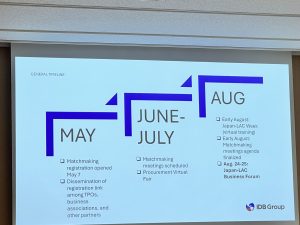
Day Two of the Forum, on August 25, is built around that proposition: 25-minute, pre-matched one-on-one meetings, interpreted in four languages, in two tracks. One pairs Japanese importers and exporters with LAC counterparts across food, beverages, chemicals, pharmaceuticals, industrial machinery, and electrical equipment. The other connects Japanese investors, corporates, foundations, startups, and universities with LAC investment-promotion agencies and the IDB Group’s procurement, IDB Invest, and IDB Lab teams. The IDB itself purchases roughly $5 billion in goods and services a year through its loan operations — a market most Japanese suppliers have never approached.
Day One frames the strategic conversation around energy security and critical minerals, agribusiness, digital transformation, disaster risk management, the silver economy, trade and investment integration, and venture capital. Day Three takes a smaller Latin American delegation into Japanese companies and institutions for field visits.
For a region of 48 IDB member countries seeking new growth engines, the bet is that Japan offers a distinctive value proposition — patient capital, quality engineering, and trust built quietly through JICA and the IDB over half a century. “Japanese companies can bring a lot of quality into the projects,” Soares said. “They could be very good partners.” With registration now open, the question is whether the Japanese mid-market — and the Latin American counterparts the IDB is working to grow — meet on the bridge that this Forum is designed to build.
Registration and more details: www.japan-lac.org