


JStories — Impact investing has surged worldwide, but one stubborn problem has held it back: how do you actually measure the social good an investment creates? Unlike financial returns, “impact” is diverse, case-specific and notoriously hard to quantify — and as a result, it has rarely been given real weight in investment decisions.
Tokyo-based Impact Circle, Inc., founded in July 2021, is trying to change that. In March 2026, the company took first place in the financial innovation category of the Tokyo Metropolitan Government’s Tokyo Financial Award 2025, recognition for a model that tackles impact measurement not in theory but through its own hands-on lending business.
“Even if two sectors generate the same profit, a society that treats the one solving a social problem exactly the same as the one that isn’t seems a little off to me,” said Satoshi Takahashi, the company’s representative director and CEO. “I want to contribute to a society where money circulates more actively and people gather around areas that are genuinely creating positive impact.”
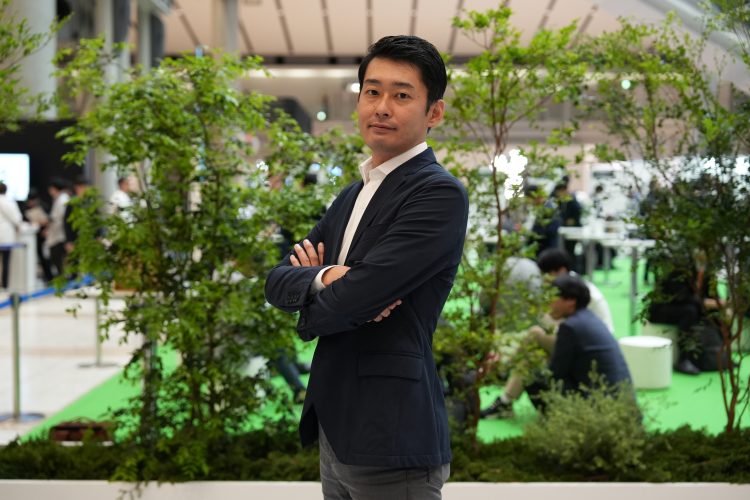
Takahashi knows the startup grind. He was a founding member and director of Global Mobility Service, a financial-inclusion fintech, where he oversaw business development across several countries, led 2 billion yen ($13 million) in fundraising across Series A to C rounds, and helped grow the company from launch to 300 employees before founding Impact Circle.
Two businesses, one ecosystem
Impact Circle runs on two connected pillars.
The first, its impact finance business, provides loans and leases in the Philippines and Japan to people who want to work but lack the means to do so. Today that mainly means vehicles for drivers and boats for fishermen, but the underlying aim is to create employment opportunities regardless of industry. According to the World Bank, roughly 1.4 billion lower-income people worldwide have no bank account, and conventional lending — which weighs past income and assets — often leaves them unable to find work. In the Philippines, about 1 million of the country’s roughly 4 million drivers cannot afford their own vehicles, trapping them in a cycle of perpetual rental fees and poverty.
What separates Impact Circle from a conventional lender, Takahashi says, is that it evaluates and prices its financing based on impact — specifically, how a loan helps maintain or raise a driver’s income. To manage risk, the company works with local cooperatives and uses a vehicle-recovery model to protect its financial health.
The idea grew out of Takahashi’s own experience. “Social value and financial value should be linked, but in the market at the time they were treated as separate things,” he said. “Improved repayment capacity and a financial institution’s brand value — these are all part of impact. Making that connection is the starting point of our business.”
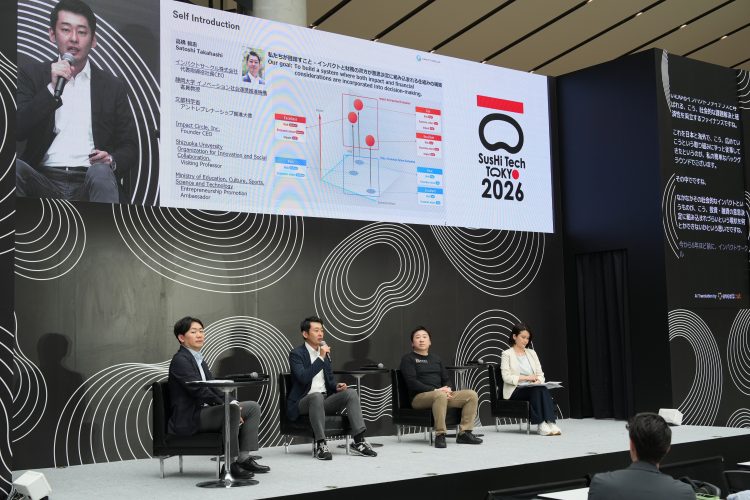
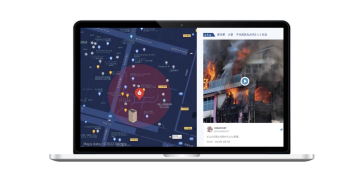
The second pillar, its impact visualization business, makes visible the social impact a company, project or individual can generate — offering “impact” as a new axis for decision-making alongside risk and economic return. Delivered as an end-to-end consulting and BPO service covering everything from process design to data collection and reporting, it is already used by major Japanese corporations. The company is now systematizing that know-how into a SaaS platform called Impact Cloud IC.
“As a system for impact investing, we’re probably the first in Japan,” Takahashi said. “There are similar systems in the West, but they focus mainly on sustainability data management. We’re building from the ground up — from designing the blueprint for impact, to setting indicators, to collecting data — with a focus on creating impact itself.”
The two businesses reinforce each other. The lending operation doubles as a living laboratory for impact measurement: because the company runs its own finance business, it accumulates real-world know-how on visualization, which in turn makes the financing smarter and helps it grow.
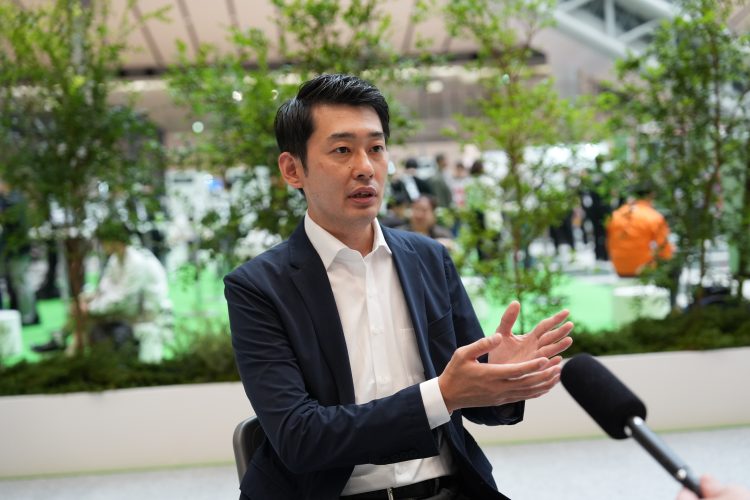
“It’s not just about ‘taking impact into account,'” Takahashi said. “It’s about how you actually change investment decisions. Whether you’re seriously working on that is what separates us from conventional finance.”
Backing from major institutions
The model is drawing institutional support. In November 2024, Impact Circle raised 335 million yen ($2.2 million) in a Series A round led by Environmental Energy Investment, which runs an impact fund, and has launched a joint project with Mitsubishi Research Institute. Through a capital and business alliance with Mitsui Sumitomo Insurance, it is also co-developing a financial-inclusion impact finance service aimed at solving last-mile delivery challenges.
As global interest in ESG and impact investing grows, visualization and measurement remain the field’s biggest hurdles. Impact Circle’s answer is to accumulate real data through its own lending operations, then turn it into a system and a platform — and the Tokyo Financial Award, where it topped an innovation-category field that included Clarity AI, Myna Wallet and three other startups, suggests specialists see promise in that approach.
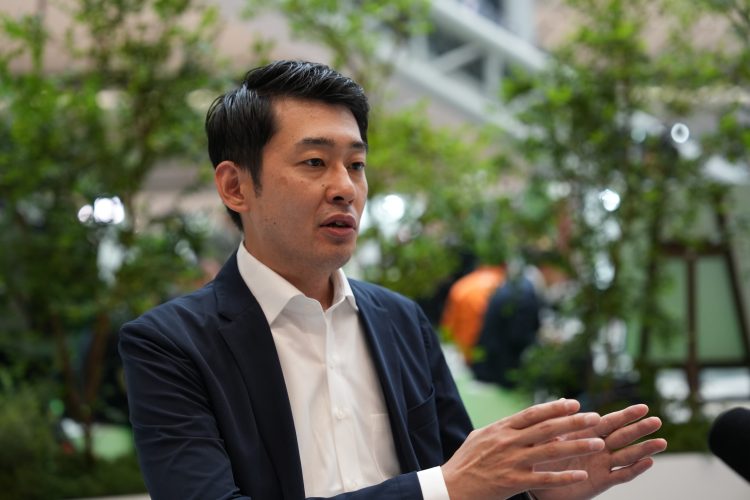
“Unlike ESG, there’s no clear standard for impact visualization,” Takahashi said. “That’s exactly why we needed a system anyone can use without specialized expertise, one that dramatically cuts the workload. I want to take on that challenge together with people who genuinely want to build social value into their decisions.”
Written by Takanori Isshiki | JStories
Top photo: Moritz Brinkhoff | JStories
For inquiries regarding this article, please contact jstories@pacificbridge.jp