
• Login
Upgrade
JStories
  • 日本語
  • 中文 (中国)
No Result
View All Result
  • Home
  • AI
    • Artificial Intelligence
    • Robotics
    • Mobility
    • FinTech
    • Quantum
  • Earth
    • AgriTech
    • Green Innovation
    • Disaster Tech
    • SpaceTech
    • Materials
  • Life Sciences
    • BioTech
    • HealthTech
    • MedTech
    • AgeTech
  • Society
    • Media
    • EdTech
    • Diversity
    • FemTech
    • Social Impact
  • Lifestyle
    • FoodTech
    • Beauty & Fashion
    • Wellbeing
    • Arts & Music
    • Anime
  • Travel
    • Adventure Travel
    • Luxury Travel
    • Wellness & Medical Tourism
    • Culture
  • Video
  • Deals
    • Venture Capital
    • M&A
    • Events
    • Pitch
    • Growth Support
    • Legal & IP
  • Interview
  • Opinion
  • Home
  • AI
    • Artificial Intelligence
    • Robotics
    • Mobility
    • FinTech
    • Quantum
  • Earth
    • AgriTech
    • Green Innovation
    • Disaster Tech
    • SpaceTech
    • Materials
  • Life Sciences
    • BioTech
    • HealthTech
    • MedTech
    • AgeTech
  • Society
    • Media
    • EdTech
    • Diversity
    • FemTech
    • Social Impact
  • Lifestyle
    • FoodTech
    • Beauty & Fashion
    • Wellbeing
    • Arts & Music
    • Anime
  • Travel
    • Adventure Travel
    • Luxury Travel
    • Wellness & Medical Tourism
    • Culture
  • Video
  • Deals
    • Venture Capital
    • M&A
    • Events
    • Pitch
    • Growth Support
    • Legal & IP
  • Interview
  • Opinion
en English ja 日本語 zh 中文 (中国)
JStories
No Result
View All Result

Geothermal Power Taps a ‘Buried Treasure’ to Revitalize a Hot Spring Region

Resident-led energy business brings new momentum to local economy — and could help power Japan's data center boom

Yoshiko Ohira by Yoshiko Ohira
07/07/2026
in Earth, Green Innovation, News, Social Impact
0
Home Earth
Share on FacebookShare on Twitter

JStories — Japan, one of the world’s most volcanically active countries, has the world’s third-largest geothermal resource potential, estimated at 23 gigawatts, trailing only the United States and Indonesia. That is roughly equivalent to the output of 23 typical nuclear reactors, each generating about 1 gigawatt.

Yet Japan’s installed geothermal capacity totals only about 0.5 gigawatts — just 2% of its potential. Long development timelines, land-use restrictions and the need to coordinate with local hot spring operators have long stood in the way.

Now, a new kind of renewable energy business is taking root in Kyushu, aiming to put the region’s abundant geothermal resources to work for the communities that sit above them.

The effort centers on the Waita hot spring area, at the foot of Mount Waita, straddling the border of Kumamoto Prefecture’s Aso District and Oita Prefecture’s Kusu District. Furusato Netsuden, a geothermal developer based in Oguni Town, Kumamoto Prefecture, is pursuing a community-based model of geothermal development led by representative director Kazuyuki Akaishi. Under the model, residents themselves profit from their local geothermal resources and use that income to address local challenges.

Other developers had previously tried to build geothermal projects in the area, but concerns among hot spring landowners and residents about the possible depletion or cooling of their hot spring sources made agreement difficult. The discord split the community — even leading to the cancellation of the 700-year-old Takenoyu Bon Odori festival — and earlier projects stalled.

Akaishi, who saw major potential in the region’s abundant geothermal resources, drew on his experience managing bulk electricity contracts for apartment buildings to persuade landowners who opposed the project. He worked with them one by one, gradually building consensus. A shared goal — creating a town attractive enough that residents’ children and grandchildren would want to return — gave Akaishi and the community common ground.

In 2011, 30 households in the area formed an organization called Waita-kai, and the Waita No. 1 geothermal power plant was launched. Furusato Netsuden supports the group with fundraising, asset management and operations, and the plant’s fixed income is funneled back into the community to fund infrastructure improvements, education and tourism development.
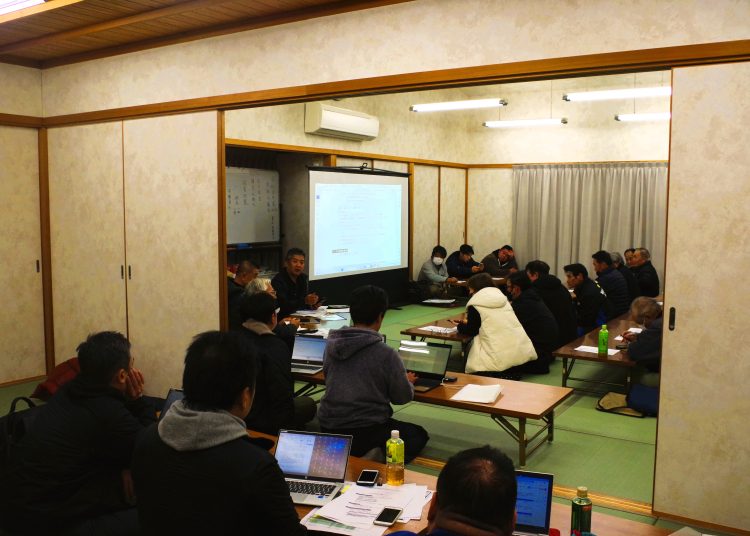
Furusato Netsuden holds regular meetings with residents to share information. Photo courtesy of Furusato Netsuden (same below).
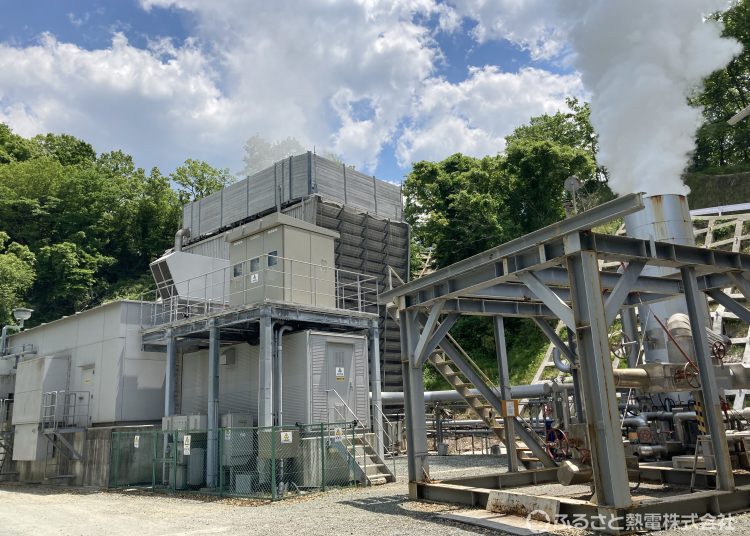
The Waita No. 1 geothermal power plant began commercial operation in 2015. Steam rising from underground drives a turbine to generate electricity. With an installed capacity of 1,995 kilowatts, the plant produces about 14 million kilowatt-hours a year — enough to power roughly 3,580 households.

Building on the success of Waita No. 1, the Waita No. 2 geothermal power plant came online in March 2026 with the aim of addressing challenges across Oguni Town. The plant has an installed capacity of about 4,995 kilowatts and generates roughly 35 million kilowatt-hours a year, enough to supply about 8,950 households.
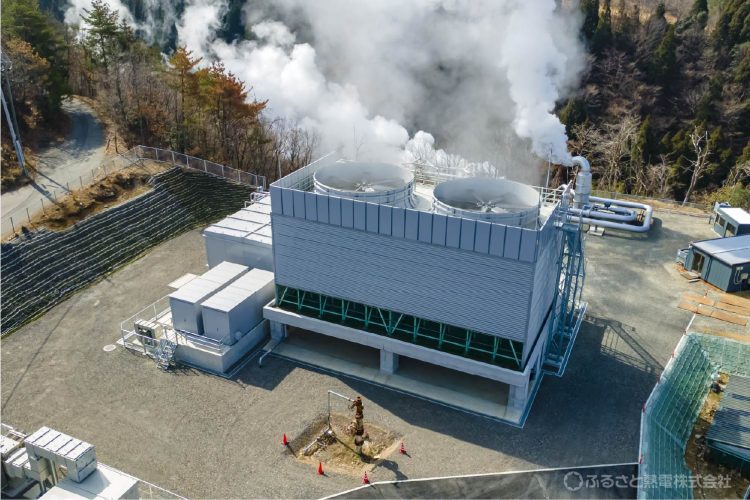
The Waita No. 2 geothermal power plant has been operating since March 2026.

“Our business isn’t simply about increasing power generation.The goal is community-building,” Akaishi said. His commitment to geothermal power in the region is rooted in a formative experience from the coal-mining region of his native Hokkaido.

“I grew up hearing stories from my grandparents’ generation about how the town thrived on its coal mines — there were even a movie theater and a bowling alley, and the whole place was full of energy. There was a time when turning underground resources into money brought vitality to the region,” he said. Drawing on that formative experience, as well as the success of the Oguni Town project, Akaishi is now also pursuing geothermal development in Teshikaga, Hokkaido.

Still, geothermal development faces ongoing challenges. Under Japan’s feed-in tariff system, the guaranteed purchase period for geothermal power is 15 years. “After that period ends, the buyback price can drop sharply even though there’s still plenty of underground resource and equipment capacity left. Geothermal is social infrastructure. We need incentive structures designed around project lifespans of 30 to 35 years for a long-term, stable power source,” Akaishi said.
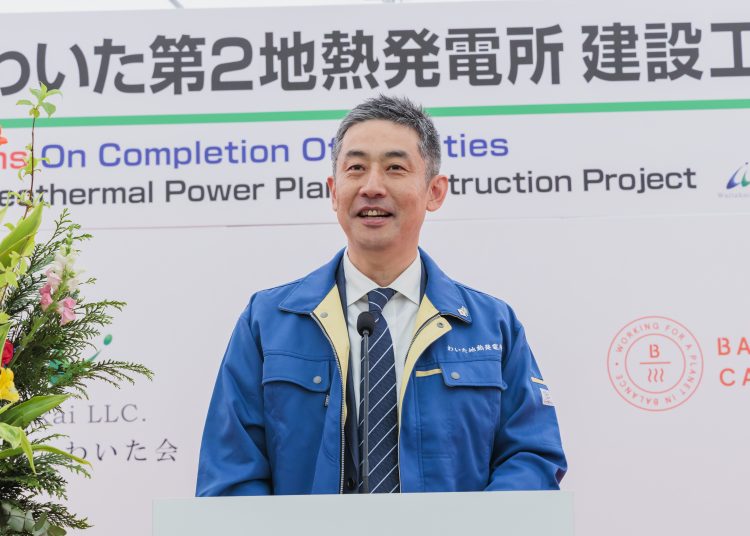
Kazuyuki Akaishi, representative director of Furusato Netsuden, describes geothermal energy not as “heat beneath the ground,” but as “the region’s own heat, the local community’s heat.”

In September 2025, Baseload Capital, a Sweden-based company that develops geothermal projects worldwide, announced a strategic investment in Furusato Netsuden, citing the potential for geothermal resource development in Japan. Baseload Capital’s shareholders include Breakthrough Energy Ventures, founded by Bill Gates, and Google.

“Take Google as an example — data centers using AI need electricity around the clock,” Akaishi said. “As the world shifts toward greener data centers, geothermal power can generate electricity steadily day and night, unlike solar or wind power, which are affected by weather, season and time of day. Given its high capacity utilization rate, geothermal power holds great promise as a baseload power source.”

The Japanese government also views geothermal power as an important domestic baseload energy source. Last year, the Ministry of Economy, Trade and Industry announced a plan to develop next-generation geothermal power — which does not require hot spring areas — at 118 locations nationwide by 2050, with the aim of expanding capacity to 7.7 gigawatts, equivalent to about seven nuclear reactors.

“People say Japan lacks resources. But regions have not only geothermal resources, but also forests and other resources. If companies respect and work alongside local communities, resource development will accelerate,” Akaishi said.

“If we can build greater recognition of the value of geothermal power’s stable supply and pursue policies that allow geothermal development to coexist with local communities, regions will start to move. And once regions start to move, society will change. We aim for the day when what we’re doing becomes the global standard,” he said.


Translated by Mark Goldsmith

Edited by Mark Goldsmith

Top photo: Furusato Netsuden

For inquiries regarding this article, please contact jstories@pacificbridge.jp
Tags: Baseload PowerCommunityGeothermal PowerJapan TechKumamotoKyushuRenewable EnergyTechnology
Previous Post

As deepfake scams spread, a Japanese institute builds detectors to catch them

Yoshiko Ohira

Yoshiko Ohira

Related Posts

As deepfake scams spread, a Japanese institute builds detectors to catch them
Artificial Intelligence

As deepfake scams spread, a Japanese institute builds detectors to catch them

by JStories Editorial Team
07/03/2026
Sony’s neck-worn cooler targets a world running short on ways to beat the heat
Green Innovation

Sony’s neck-worn cooler targets a world running short on ways to beat the heat

by JStories Editorial Team
07/01/2026
As the World Cup heats up, Japan’s cooling-wear industry sees its moment
Beauty & Fashion

As the World Cup heats up, Japan’s cooling-wear industry sees its moment

by JStories Editorial Team
06/18/2026
Japan’s Shionogi puts a last-resort antibiotic in the hands of doctors in 27 countries
MedTech

Japan’s Shionogi puts a last-resort antibiotic in the hands of doctors in 27 countries

by Toshi Maeda
06/15/2026
Japanese telecom bets on liquid cooling to take the heat out of AI’s energy crisis
Artificial Intelligence

Japanese telecom bets on liquid cooling to take the heat out of AI’s energy crisis

by Toshi Maeda
06/12/2026

Leave a Reply Cancel reply

Your email address will not be published. Required fields are marked *

Trending

Greening the desert with trash

by Yui Sawada
03/23/2023
0

KYOTO (JStories) - The sight of local Niger women throwing kitchen waste out into the African desert inspired a project...

The world’s first drug that helps patients ‘grow new teeth’

by Ruiko Kokubun
09/22/2023
0

KYOTO (JStories) - The conventional way to help people who have lost teeth due to tooth decay or aging has...

Evolutionary artificial protein slated for market debut as early as June 2026

by Yoshiko Ohira
04/17/2026
0

JStories — Severe and hard-to-heal wounds — such as those caused by burns, injuries, pressure ulcers, skin cancer surgery, and...

Ai Heart Japan

Ai Heart Japan

by Jstories
06/18/2024
0

https://www.youtube.com/watch?v=q0fmsRv3ZjQ Company Profile Startup Name: Ai Heart Japan Co., Ltd. Stage: Early-stage (founded March 30, 2021) Location: Japan Website: https://ai-heart.jp/...

JStories

©Articles and photos published on JStories are protected by Japanese copyright law and international treaties. They cannot be reproduced without the permission of the copyright holders

Explore JStories

  • Home
  • About JStories
  • JStories Newsletter Sign-Up
  • Company
  • Team
  • Contact
  • Privacy Policy
  • Partner Press Releases

Follow Us

Welcome Back!

Login to your account below

Forgotten Password?

Retrieve your password

Please enter your username or email address to reset your password.

Log In
No Result
View All Result
  • TOP STORIES
  • AI
    • Artificial Intelligence
    • Robotics
    • Mobility
    • FinTech
    • Quantum
  • Earth
    • AgriTech
    • Green Innovation
    • Disaster Tech
    • SpaceTech
    • Materials
  • Life Sciences
    • BioTech
    • HealthTech
    • MedTech
    • AgeTech
  • Society
    • Media
    • EdTech
    • Diversity
    • FemTech
    • Social Impact
  • Lifestyle
    • FoodTech
    • Beauty & Fashion
    • Wellbeing
    • Arts & Music
    • Anime
  • Travel
    • Adventure Travel
    • Luxury Travel
    • Wellness & Medical Tourism
    • Culture
  • Video
  • Deals
    • Venture Capital
    • M&A
    • Events
    • Growth Support
    • Legal & IP
  • Interview
  • Opinion

©Articles and photos published on JStories are protected by Japanese copyright law and international treaties. They cannot be reproduced without the permission of the copyright holders

Not enough quota to unlock this post
Unlock left : 0
Are you sure want to cancel subscription?