





PROBLEM: Global data center electricity consumption is on track to exceed 1,000 terawatt-hours this year, straining power grids and threatening to derail both AI expansion and national climate targets.
POTENTIAL SOLUTION: Japanese telecom giant KDDI, working with Mitsubishi Heavy Industries, has commercialized liquid immersion cooling for AI data centers, cutting server cooling energy use by 94 percent and is now deploying it at industrial scale in Osaka.
AI is running out of power. Not computing power, but electricity. Global data centers have consumed roughly 415 terawatt-hours in 2024. With the International Energy Agency projecting that figure to exceed 1,000 terawatt-hours this year. Data centers might consume the equivalent to Japan’s entire annual electricity use. A single rack of next-generation AI chips now draws close to one megawatt of power, enough to supply around 750 average American homes.
Cooling those racks accounts for a substantial portion of that load. Conventional air-cooled data centers run at a Power Usage Effectiveness, or PUE, of around 1.7, meaning that for every unit of energy powering a server, another 0.7 units are spent on cooling and overhead. As AI workloads grow denser and hotter, that overhead is becoming unsustainable.
KDDI Corporation, one of Japan’s three major mobile carriers, thinks they have come up with the answer.
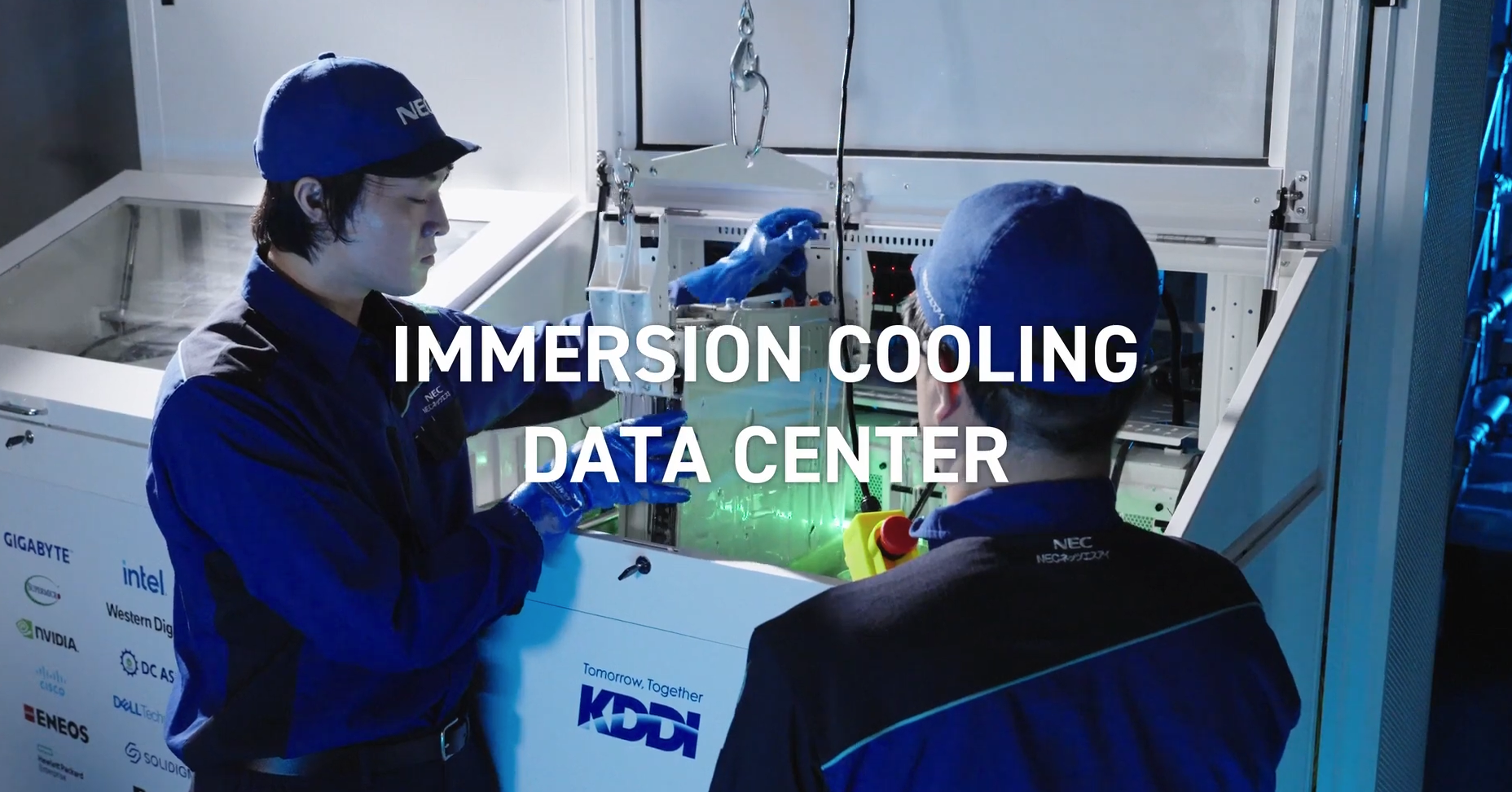
Servers in fluid
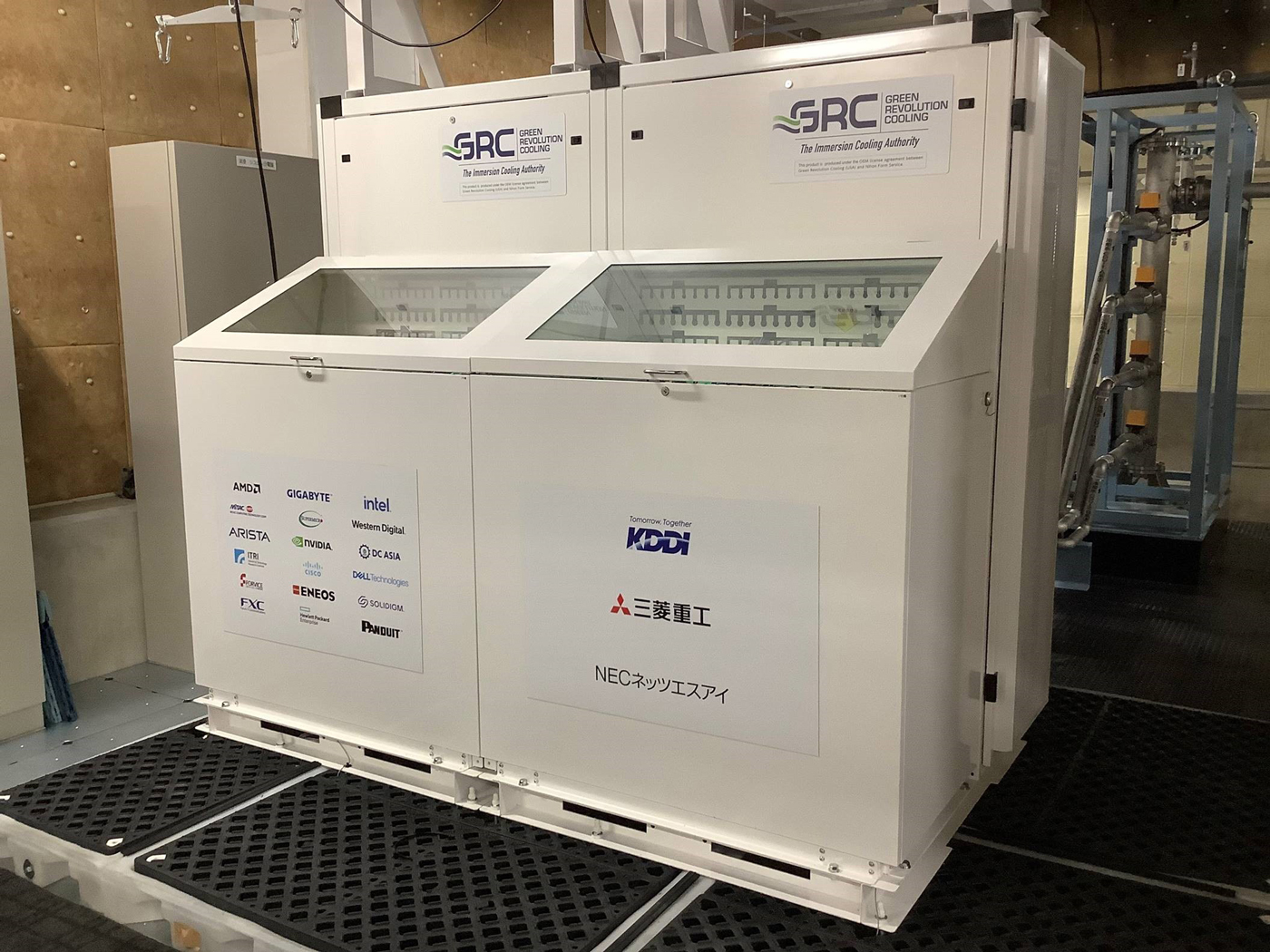
In 2023, KDDI, Mitsubishi Heavy Industries (MHI), and network integrator NEC Networks & System Integration Corporation completed demonstration testing of an immersion cooling system at KDDI’s Oyama Network Center, in Tochigi Prefecture north of Tokyo. The method submerges servers in a tank of dielectric fluid, a non-conductive liquid that draws heat directly from the chips without electricity-hungry air conditioning. The results were striking: cooling energy consumption fell 94 percent compared with conventional air-cooled systems, and PUE dropped to 1.05.
That 0.05 overhead, against an industry norm of 0.7, represents a meaningful efficiency gain for any operator running hundreds of megawatts of AI compute around the clock.
The three companies moved from demonstration to commercialization in 2023, with containerized deployments designed for flexible installation. Last year, KDDI took the next step, announcing a full-scale AI data center in Sakai City, Osaka Prefecture, built with HPE and powered by NVIDIA’s GB200 NVL72 rack-scale systems. The Osaka Sakai Data Center combines air cooling and direct liquid cooling in a hybrid design targeting reduced environmental impact for AI training workloads. KDDI plans to serve startups and enterprises building large language models through its WAKONX AI business platform.
A commercial answer to an industrial problem
The broader context matters. Data center power demand is growing faster than grid infrastructure can support. In the United States, grid operator PJM projects a six-gigawatt shortfall by 2027. In Japan, the government has flagged data center energy consumption as a structural challenge to its 2050 carbon neutrality target.
Liquid cooling is not a new idea. Google, Microsoft and Meta have all experimented with variations. What KDDI and MHI have demonstrated is a verified path from lab trial to Tier 4-certified commercial operation in a hyperscale environment, using equipment developed and manufactured in Japan.
Immersion cooling does have real constraints. Servers submerged in fluid are harder to service than rack-mounted air-cooled equipment. Maintenance requires lifting hardware out of tanks, draining and cleaning components, adding time and complexity. The dielectric fluids used carry their own procurement and disposal considerations. And immersion cooling addresses the energy cost of cooling specifically, not the total power draw of the AI chips themselves, which continues to rise with each new GPU generation.
Japan’s liquid cooling push will not, on its own, resolve the global data center energy crisis. But KDDI’s progression from a container trial to an operational Osaka facility with NVIDIA Blackwell hardware illustrates how efficiency gains that began as research claims are becoming the baseline expectation for any new AI infrastructure built today.
Evidence and context
The 94 percent cooling energy reduction comes from the February 2023 demonstration test at KDDI’s Oyama Network Center, jointly conducted by KDDI, MHI and NESIC, and published in a press release by all three parties. The PUE of 1.05 compares against a typical conventional data center PUE of 1.7. These figures come from a controlled demonstration, not yet from multi-year operational data at hyperscale. No independent third-party audit of the 94 percent figure has been publicly published; the claim should be treated as manufacturer-reported until verified.
Japan’s data center cooling market reached $2.8 billion in 2025 and is projected to grow to $7.2 billion by 2034, according to IMARC Group, driven by AI adoption and Japan’s carbon neutrality commitments. Globally, data center electricity demand is projected to reach 945 terawatt-hours by 2030, according to the IEA.
KDDI is not alone in Japan’s liquid cooling space. Fujitsu introduced power-saving liquid cooling technologies for AI data centers in 2024, integrating edge computing for fault detection. Toshiba showcased power semiconductor solutions at APEC 2026, including a top-side cooled TOGT package engineered for thermally demanding, high power-density applications, enabling heat dissipation through the top of the package to reduce thermal stress on the PCB. Globally, Google, Microsoft and Meta are pursuing nuclear and large-scale renewable procurement as complementary strategies, while companies including ZutaCore are offering direct-to-chip liquid cooling systems that MHI has also incorporated into its product lineup.
The limitations are real. Immersion cooling reduces the energy cost of keeping servers cold, but does not reduce the power drawn by the AI chips themselves. Each new GPU generation demands more electricity per rack, meaning efficiency gains risk being outpaced by raw compute growth. Liquid cooling infrastructure is more capital-intensive upfront than air cooling. Adoption in legacy data centers is slow because retrofitting existing facilities is costly. And the dielectric fluids used in single-phase immersion systems require careful handling and disposal, adding operational complexity.
The core insight is straightforward. Conventional air conditioning was designed for a world where server racks drew 10 to 50 kilowatts. AI racks now approach one megawatt. The physics of air cooling at that density do not work. Japan’s investment in liquid cooling as a commercial product, rather than a research experiment, reflects an early recognition that the infrastructure assumptions of the cloud era cannot simply be scaled up to meet the AI era’s demands.
For inquiries regarding this article, please contact [email protected].