




Meet Global, produced by Business Next Media in Taiwan, showcases Asia’s most dynamic startups, groundbreaking technologies, and cross-border innovations. It provides a global perspective on how entrepreneurship and collaboration are shaping the future of business and society. JStories features selected content from Meet Global, bringing readers fresh perspectives on innovation and the people driving positive change across Asia.
“Ramen is sooo good.” That tweet from Tesla CEO Elon Musk on X became a golden piece of publicity for Yo-Kai Express (hereafter referred to as Yo-Kai) in its early startup days.
💕🍜 ramen is sooo good🍜 💕
— Elon Musk (@elonmusk) December 14, 2018
In Japanese, “Yo-Kai” means ghost or spirit, something that can appear anytime, anywhere. That idea shaped founder Andy Lin’s vision for Yo-Kai Express: delivering instant, ready-to-eat meals wherever and whenever they are needed.
The company began with automated ramen machines, using semiconductor and rapid-heating technology to serve a hot bowl in under a minute. Today, its machines can be found in more than 150 locations, including Taoyuan International Airport, cities across North America, and Japan. Yo-Kai is now expanding into automated bubble tea, with plans to list on Nasdaq by the end of 2025.
While the move from meals into beverages seems like a logical step in a labor-strapped food service industry, Andy Lin says it also reflects pressure from operating costs and a shift in market strategy. That mindset goes back to the company’s earliest days, inspired by a late night when Andy Lin was working overtime and couldn’t find a hot meal nearby.
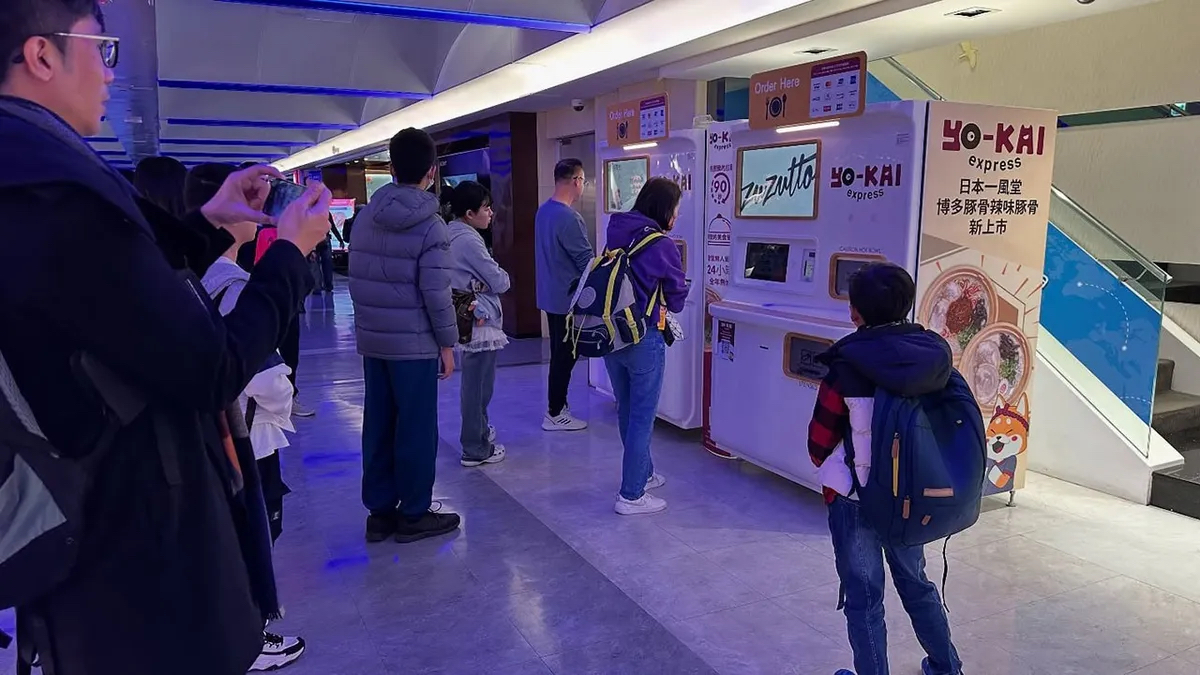
Chef-quality ramen, ready in seconds
In the United States, long distances and low population density mean that after dark, it is often hard to find a restaurant open. Having lived through the 2001 dot-com bust and the 2008 financial crisis, Andy Lin noticed that the global economy seems to hit a downturn every few years. In such periods, people tend to rely more on low-cost, unmanned solutions. He saw a clear opportunity for automated food vending in the U.S.
“Can automation solve this problem?” This was the question and the challenge for Andy Lin, who had worked in the semiconductor industry for more than 12 years.
From a technical perspective, Yo-Kai does not serve “microwave food.” Ingredients are prepared using proprietary recipes, then partially cooked and flash-frozen. When a customer places an order, the food is reheated to 300°C in seconds, ensuring it is fully cooked but never overdone.
Yo-Kai’s competitive edge lies in applying a semiconductor production mindset to heating.Semiconductor manufacturing depends on precision, standardization, and modular processes to achieve high yields. Yo-Kai adapted that same approach by modularizing ingredients, standardizing workflows, and using robotic arms for precise calculations. Inside the machine, everything happens fast, accurately, and efficiently, much like a chef preparing food on the spot.
Another major advantage for Yo-Kai is that it controls all aspects of machine design in-house. This allows the company to update its products every six months and even launch to market first, then refine the design in real time.
Andy Lin gives an example. When some older customers had trouble with the touchscreens, the team discovered that the issue was caused by the different angles at which they tapped the screen. Yo-Kai’s engineers were able to make adjustments immediately.
Old chain setback turns into an opening for bubble tea expansion
Andy Lin admits that the biggest challenge for automated vending machines is the cold chain supply network. “Cold chain logistics in the U.S. are extremely costly, which makes scaling and opening new locations difficult.” This was also a key reason Yo-Kai decided to move into the beverage market.
Why would shifting to beverages solve the supply chain problem? Lin explains that drinks have higher margins and, compared to meals, most consumers are less tied to specific flavors. “If you gave someone a blind taste test, it would be hard for them to guess which tea came from which brand.” Most importantly, beverage ingredients can be prepared at room temperature. “As long as the products can be shipped without refrigeration, any logistics provider can handle delivery, and location choices become far less restricted.”
Once the location requirements are lowered, Yo-Kai can place machines more densely, which in turn reduces supply chain and logistics costs. In other words, the move into automated bubble tea is a way to expand locations and secure market presence. Later, by placing automated meal machines in those same locations, the company can use economies of scale to gain leverage in cost negotiations with suppliers.
During this transition, another key decision was to move its R\&D center back to Asia.
“If we cannot change the cost of cold chain delivery in the U.S., then I will lower food costs instead. Importing from Asia can cut costs by about 25 percent,” Andy Lin explains. Beyond cost advantages, Asia offers advanced flavors and frozen food processing techniques, allowing Yo-Kai to quickly diversify its menu and sourcing. “Taiwan is an excellent R\&D hub, with low ingredient costs, strong food processing capabilities, semiconductor expertise, and skilled talent.”
Opening to franchises to boost market presence
A business plan on paper is one thing, making it work in the real world is another.
Yo-Kai originally planned to operate all of its machines directly. However, the costs of management and coordination with location partners proved high, so Andy Lin decided to introduce a franchise model. “Since these are unmanned machines, opening a location can be a simple investment rather than a major one.”
He gives an example. Renting a machine costs around $4,000 per month. If a drink sells for $6 and the machine sells 1,500 cups in a month, the return on investment would be 100 percent. “You can think of it as an upgraded version of a cloud kitchen. We don’t need staff, and the footprint is small.”
To open up the consumer market, Yo-Kai plans to go public by the end of 2025. The goal is to boost visibility and use capital from the market to speed up expansion.
The company is already in talks with an air conditioning firm to lease freezer storage, which will help accelerate new location rollouts and lay the groundwork for building its own logistics network. “We hope to use this approach to bring Taiwan’s food and dining culture overseas,” Andy Lin says.
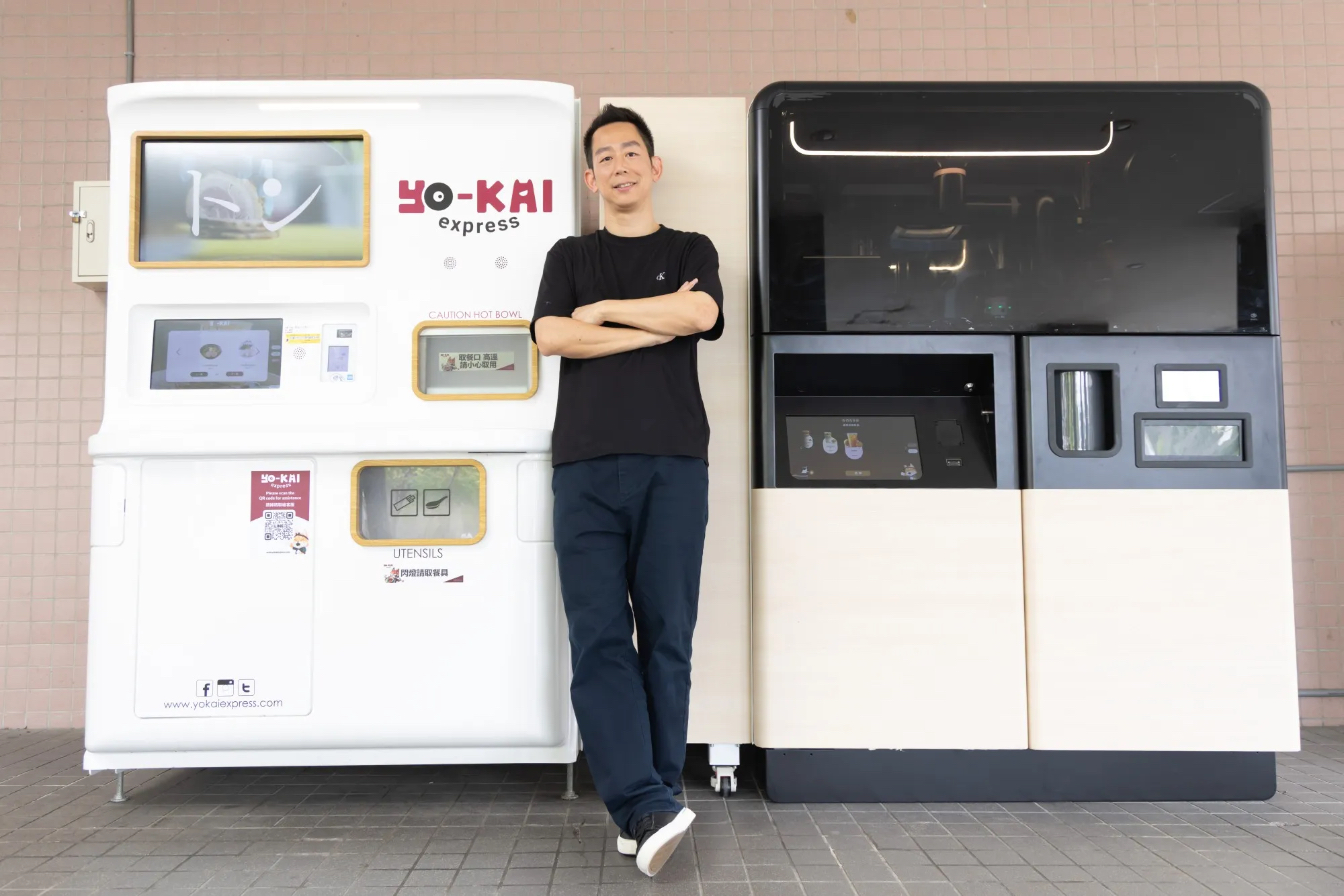
Yo-Kai Express
Founder:Andy Lin
Product and technology: Automated ramen machines, automated bubble tea machines
Funding: Total funding of USD 19 million, with investors including Ippudo, Pulmuone.
This article is republished with permission from Business Next.
Author: Vincent Tseng.
Original title:燒到馬斯克的無人拉麵機!Yo-Kai Express煮麵當晶片做,加碼台味手搖機拚年底上市
Editor: Lea Hintzy.
To read the original article and more stories about what Taiwan offers, please visit Meet Global website